Tuesday, July 19, 2016

Yosemite National Park: Mist Trail to Vernal and Nevada Falls (Blog Hike #590)

Trails: Mist and John Muir Trails
Hike Location: Yosemite National Park
Geographic Location: eastern end of Yosemite Valley, CA (37.73242, -119.55993)
Length: 6 miles
Difficulty: 10/10 (Difficult)
Date Hiked: June 2016
Overview: A semi-loop along the Merced River passing two gigantic waterfalls.
Photo Highlight:
Hike Video: 

Directions to the trailhead: This hike starts at the Nature Center at Happy Isles in the extreme southeastern corner of Yosemite Valley.  Ideally you can park in the large day-use parking lot near Curry Village (currently known as Half Dome Village due to a trademark dispute).  Realistically, you need to park anywhere you can find a space in eastern Yosemite Valley and either walk or ride the free Valley Shuttle to the Happy Isles trailhead.  Happy Isles is Valley Shuttle stop #16.

The hike: For my general comments on Yosemite National Park, see the previous hike.  The Mist Trail, the first 2.2 miles of which are described here, is Yosemite’s signature hike, which means two things.  First, everyone who comes to Yosemite seems to end up on the Mist Trail, making this trail the most popular and crowded trail in a very popular and crowded park.  Second, if you are a hiker who comes to Yosemite, you have to hike this trail too.  According to news reports even President Obama hiked part of this trail during his June 2016 Yosemite vacation, and I hiked this trail only 3 days after he did.
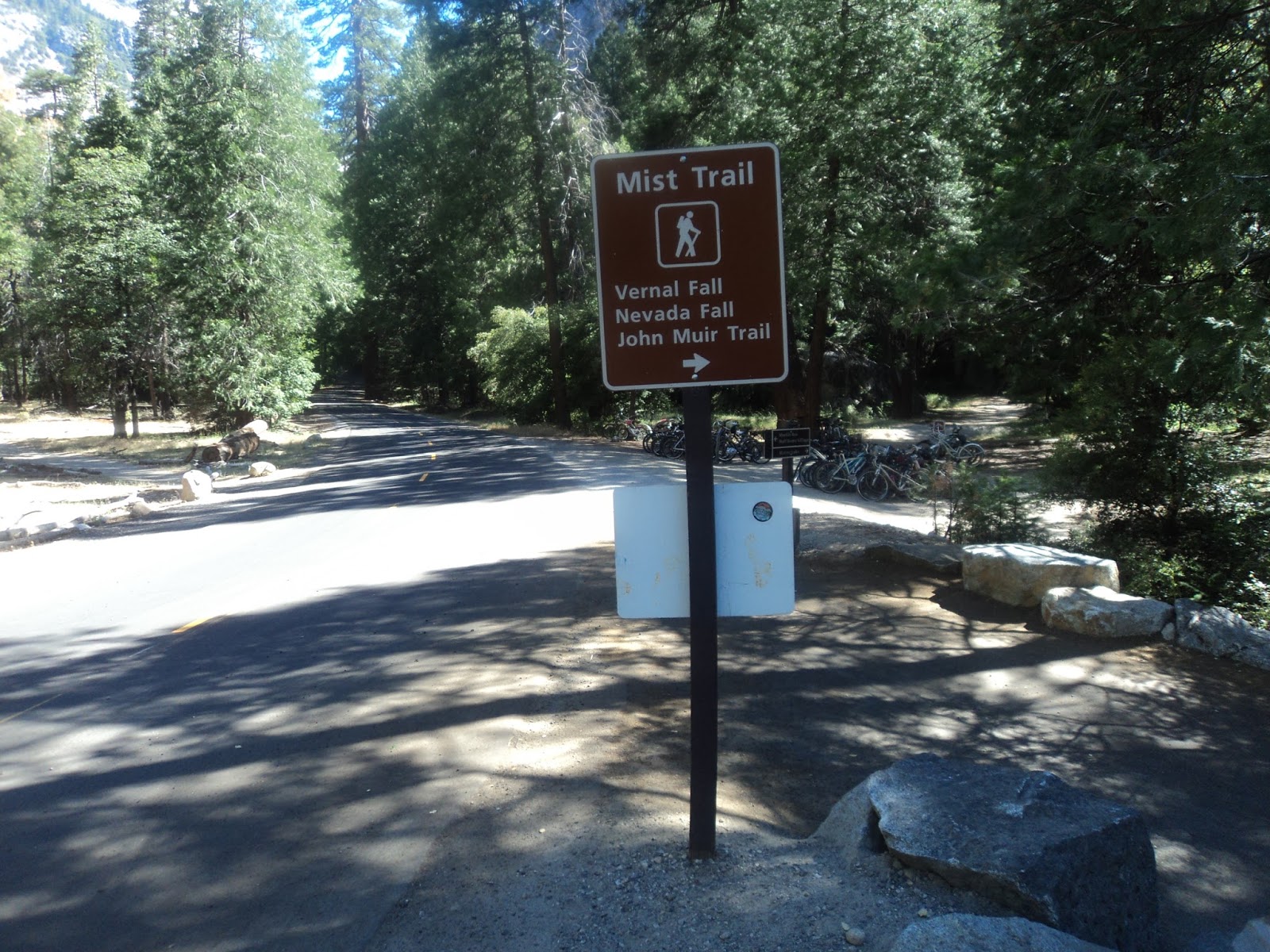
Trailhead: Mist Trail
            The shuttle bus will drop you off on the south side of the Merced River, but the Mist Trail starts on the north side of the Merced River.  Thus, your hike starts by crossing the river on the park road bridge.  This road used to be open to all vehicles, but these days only shuttle buses and vehicles with handicapped placards are allowed to be driven here.
            The wide asphalt path heads upstream through a grove of pine trees with the river on your right.  The river’s water level varies from a tranquil stream in the fall to a raging torrent during the snowmelt season.  Thus, the water volume of Vernal and Nevada Falls varies as well.  While it may be helpful to plan a June visit like I did to maximize the water volume, these river waterfalls rarely dry up completely like some of Yosemite’s other waterfalls do.
Asphalt section of Mist Trail
            Over the first 0.2 miles, the Valley Loop Trail exits left to head for Mirror Lake, and you pass a river monitoring station on your right.  This initial segment of trail is nearly flat, and as this hike’s 10/10 difficulty rating suggests it is pretty much the only flat area on this hike.  The trail soon curves left and passes a High Sierra Loop Trail mileage sign featuring trail distances to famous destinations such as Half Dome, Tuolumne Meadows, and even Mount Whitney (211 miles away and well outside the park’s boundaries).  The climb now begins on a moderate to steep grade.  The trail threads its way between Grizzly Peak’s nearly vertical cliffs rising to the left and the river, which is now many feet below you to the right.
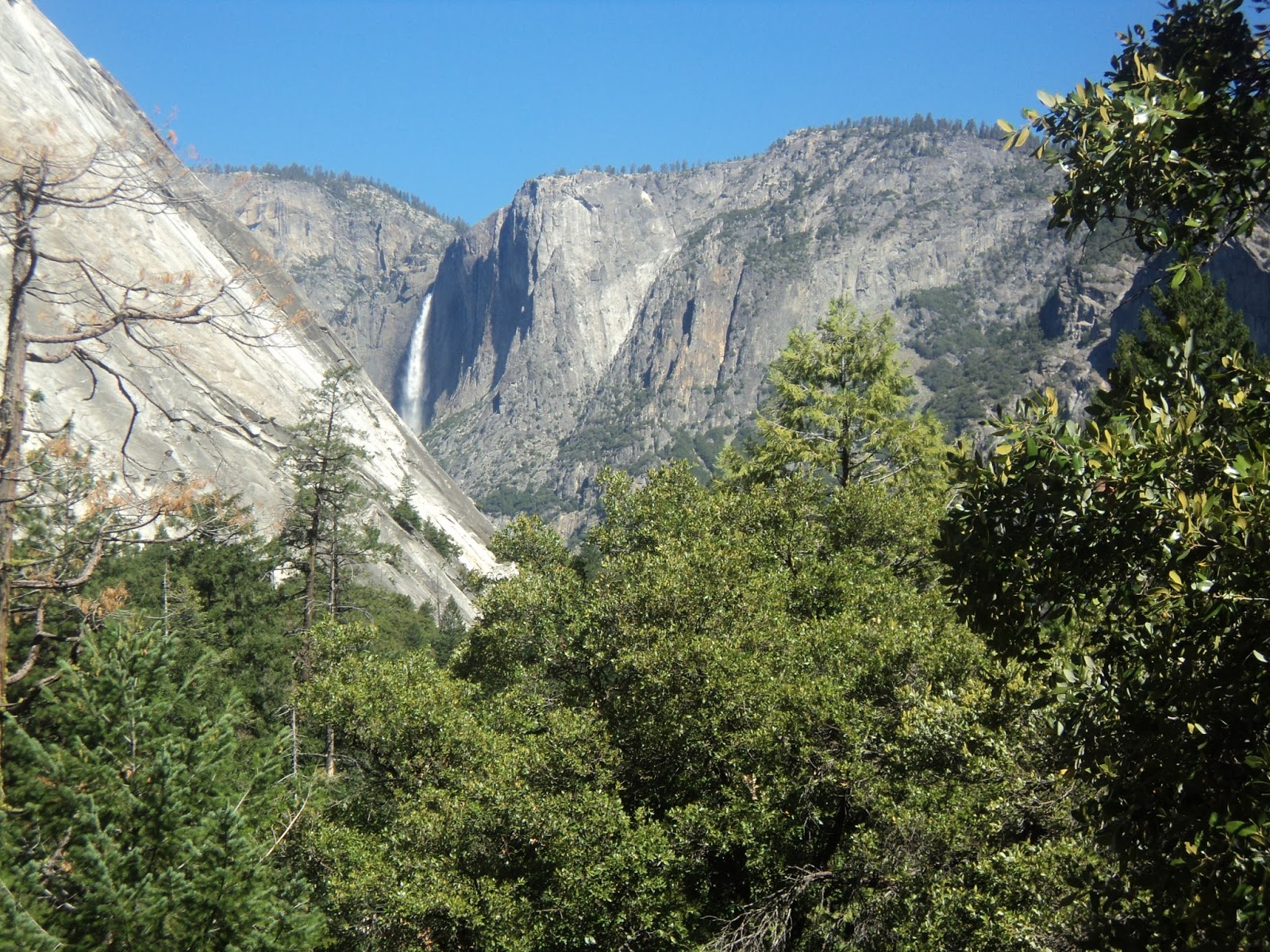
Upper Yosemite Fall
            As you begin to gain elevation out of Happy Isles, a view of Upper Yosemite Fall materializes between the granite cliffs over your shoulders.  Some cascades appear in the river as the asphalt trail navigates through some boulder fields.  At 0.6 miles, the park’s best view of Illilouette Fall appears up a side ravine across the river.  At 370 feet tall, Illilouette Fall would be a show-stopper at most parks, but it is only a warm-up act at Yosemite.
Illilouette Fall
            More climbing comes before a brief descent to the Vernal Fall Footbridge, which is reached 1 mile and 350 feet of elevation gain into the hike.  Standing on this bridge and looking upstream gives this hike’s first view of Vernal Fall, hence the bridge’s name.  Crowds tend to congregate here, and people in below average physical condition sometimes turn around here.  Some rocks make for nice places to sit and rest for the remainder of the climb, and a drinking fountain at the far side of the bridge provides the last chance to top off your water bottle.  The drinking fountain was a popular amenity on my visit: I hiked this trail on a hot early afternoon with temperatures in the low-to-mid 90’s.
View from Vernal Fall footbridge
            Now back on the south side of the Merced River, climbing a couple of switchbacks brings you to a trail intersection at 1.2 miles.  The Mist Trail continues straight here while the John Muir Trail exits right.  The John Muir Trail offers an alternate route to the top of Nevada Fall, and signs identify it as the winter route for reasons to be seen in a few minutes.  I chose to form a loop by continuing straight here and using the trail going right as a return route, thus hiking up the Mist Trail and coming back down the John Muir Trail.
            The asphalt trail surface turns to dirt and rock just past this trail intersection.  The Merced River becomes rockier with more cascades as you approach the base of Vernal Fall.  At 1.3 miles, you exit the forest to pass around a rock outcrop and begin climbing the 600 granite steps for which this trail is infamous.  The steps are the hardest part of this hike: some of them are more than 1 foot tall, and the trail gains nearly 400 feet of elevation over the next 0.2 miles.
Climbing the granite steps
If you are hiking at high river levels like I was, this point marks your entrance to Vernal Fall’s spray zone, and now you start to learn why this trail is called the Mist Trail.  Some people bring ponchos to wear while hiking through the waterfall’s spray, but I found that the cool snowmelt-fed mist felt refreshing on a hot summer day.  Footing can be an issue: not only does the mist make the granite steps slippery, but also water runs down the steps and collects in puddles that must be waded through.  In the winter the mist can freeze, thus forcing park officials to close the trail and send hikers up the winter route you passed earlier.  On the bright side, the open area offers fantastic views of Vernal Fall, and the view back down toward Yosemite Valley is not bad either.
Vernal Fall
After a few hundred feet you exit the mist by reaching land that is more beside the waterfall than down from it.  Many people use this point as a staging area for the steepest steps, which come next.  The steep, narrow set of steps carved from the granite take you to the top of Vernal Fall, and an iron fence along the narrowest part of trail provides protection against falling down the sheer cliff.
At 1.6 miles, you reach an overlook perched on the bare granite at the top of Vernal Fall.  This overlook provides a fantastic view back down the Merced River, as sheer granite cliffs line the tight river valley.  Happy Isles and Yosemite Valley lie 1000 feet below, but they are not visible from here due to a bend in the valley.  Take some time up here and enjoy the visual fruits of your labor.
View from top of Vernal Fall
Most people turn around at the top of Vernal Fall.  However, Nevada Fall, another gigantic waterfall, lies less than 2 miles upstream, and you have already done most of the required climbing to get a good view from its base.  Thus, this hike continues up the Mist Trail, which now parallels the Merced River on bare granite.  Note that a restroom building is located to the right here if it is needed.
The rocky Mist Trail above Vernal Fall
The trail continues up the south bank of the Merced River on a rocky but fairly flat course.  The sheer granite faces of Mount Broderick and Liberty Cap appear ahead and to the left.  At 1.8 miles, the upper end of the signed winter route comes in from the right.  The trail exiting right also leads to Clark Point, and this description will use it as a return route later in the hike.  For now, continue straight to keep heading toward Nevada Fall.
Soon you cross the Merced River again on another wide wooden footbridge.  This area is known as Silver Apron.  Another 0.3 miles of gradual climbing over slightly rocky trail brings you to a rock outcrop that gives a fantastic view of Nevada Fall.  At a height of 594 feet, Nevada Fall is the tallest waterfall on the Merced River.  The waterfall’s name comes from its location close to the Sierra Nevada mountains and upstream from Vernal Fall (“vernal” means spring, so this waterfall represents winter because it comes before spring).  Take some time to enjoy this second helping of giant waterfalls.
Nevada Fall, as seen from the Mist Trail
From this point, several options present themselves.  The easiest option is to simply retrace your steps back down the Mist Trail to Happy Isles, but this option will take you back through the uber-crowded Vernal Fall area.  Ahead, the Mist Trail keeps going for another mile to the top of Nevada Fall, at which point you can pick up the John Muir Trail back down to form a lollipop loop.  However, such a route requires an additional 700 feet of elevation gain and many more narrow, steep granite steps, so it should only be attempted by fit, energetic, and well-prepared hikers.  A compromise option and the one described here is to retrace your steps to the winter route at the top of Vernal Fall and follow the winter route back down.  The winter route requires another 350 feet of elevation gain, but it gets far less traffic than the Mist Trail near Vernal Fall.
Executing the third option suggested above, after re-crossing the river at Silver Apron, angle left to begin climbing on the winter route.  The entire trail from Silver Apron to Clark Point is a set of hot, sunny, rocky switchbacks.  The grade is never too steep, but it is persistent.  En route to Clark Point you pass an overlook that gives a nice side view of Vernal Fall.  Distant views of Nevada Fall will also be obtained.  From this angle, stark, rocky Liberty Cap stands just to the left of the waterfall.
Side view of Vernal Fall

Nevada Fall, as seen from the John Muir Trail
At 3.2 miles, you reach Clark Point, this hike’s highest elevation, and an intersection with the John Muir Trail.  Angle right to begin heading back down toward the Merced River.  Unlike the Mist Trail, which is hiker-only, the John Muir Trail is also open to horses, and I had to step over quite a bit of horse manure on my visit.  I also got passed by a train of horses and mules labeled as a National Park Service backcountry patrol.  Hikers are required to yield to horses, so step to the side of the trail and hide your staff (hiking staffs can spook horses) if you see a horseback rider approaching.
The John Muir Trail wastes no time in beginning its descent down a long sequence of switchbacks.  Unlike the trail up to Clark Point, these switchbacks are mostly shaded, which keeps you cooler on a hot sunny day but also blocks most views.  The trail winds endlessly down, and finally the Merced River becomes audible.  At 4.7 miles, the horse trail exits left just before you close the loop at the bottom of the winter route.  A left turn and 1.3 miles of retracing your steps down the asphalt section of the Mist Trail returns you to Happy Isles and completes the hike.  While you are in Happy Isles, the Nature Center at Happy Isles features a short, flat 0.5 mile nature trail if you want to squeeze in a little more hiking in this corner of Yosemite Valley.

Sunday, July 17, 2016

Yosemite National Park: Lower Yosemite Fall and Cook's Meadow (Blog Hike #589)

Trails: Lower Yosemite Fall and Cook’s Meadow Trails
Hike Location: Yosemite National Park
Geographic Location: eastern end of Yosemite Valley, CA (37.74855, -119.58725)
Length: 2.3 miles
Difficulty: 2/10 (Easy)
Date Hiked: June 2016
Overview: A short lollipop loop past America’s tallest waterfall and through a scenic meadow.
Photo Highlight:
Hike Video: 

Directions to the trailhead: This hike starts at the Valley Visitor Center in the eastern end of Yosemite Valley.  Ideally you can park in the large day-use parking lot across Northside Drive from the Visitor Center.  Realistically, you need to park anywhere you can find a space in eastern Yosemite Valley and either walk or ride the free Valley Shuttle to the Visitor Center.  The Valley Visitor Center is Valley Shuttle stop #5.

The hike: No less than the famous and well-traveled John Muir described Yosemite Valley and the Mariposa Grove of Giant Sequoias as “by far the grandest of all the special temples of nature I was ever permitted to enter.”  The area’s awe-inspiring white granite cliffs that tower thousands of feet above the valley, collection of waterfalls that includes some of the tallest in North America, and massive, ancient, giant sequoia trees have caused millions of visitors since Muir’s time to agree.  The two special areas originally identified by Muir were set aside in 1864 (during the Civil War by President Lincoln no less) via a federal act known as the Yosemite Grant.  The grant gave title of the land to the State of California for preservation purposes, making Yosemite the first area in the United States to receive federal protection from settlement and development.
In the early 1900’s, the land came under federal control when a group of conservationists led by Muir persuaded President Theodore Roosevelt, perhaps the greatest conservationist this country has ever known, that California was failing its stewardship responsibilities.  Sheepherders were feeding their sheep in the fragile alpine meadows, and lumber companies were cutting down ancient giant sequoias, to name a couple of travesties.  Thus, in 1903 Yosemite became America’s second national park (after Yellowstone), much to the joy of Muir and his allies.
The conservationists’ victory proved to be short-lived.  In 1913 President Woodrow Wilson approved the damming of Yosemite’s sister valley to the north, the Hetch Hetchy Valley.  This decision was made in spite of the fact that Hetch Hetchy Valley lies within the park’s boundaries set in 1903.  This act led to the creation of the National Park Service in 1916 to ensure that such short-sighted actions would never again happen within a national park’s boundaries.
The allure of Yosemite experienced by Muir remains a major attraction today, as Yosemite National Park has become one of the 5 most visited parks in the entire national park system.  Your entrance fee at Yosemite allows you to access the park for 7 days, which is a good thing: it is impossible to see the entire park in one day.  Indeed, I did my five Yosemite hikes (this one and the next four) over a three day period, and I came nowhere near exhausting the quality day hikes the park has to offer.  This hike offers a good introduction to Yosemite Valley and takes you to a couple of the valley’s most scenic and accessible sites: Yosemite Falls and Cook’s Meadow.  Be advised that this entire hike is on asphalt trail, and its location near the Valley Visitor Center means you will have a lot of company on these very developed trails.
Hike/bike path leaving Valley Visitor Center
Walk out the front of the Valley Visitor Center and angle right on one of many asphalt paths.  Your first destination is Lower Yosemite Fall, so you need to follow signs for Yosemite Falls.  The asphalt hike/bike path crosses a pair of access roads used by park employees as it heads west toward Yosemite Valley’s mouth.
At 0.4 miles, the trail to Lower Yosemite Fall exits right where the trail to Yosemite Lodge, one of the park’s main lodging establishments, continues straight.  Turn right to continue your journey toward Lower Yosemite Fall.  This trail is the eastern arm of a 1 mile loop that leads to the base of Lower Yosemite Fall.  This arm is handicapped accessible, but the western arm that you will hike later is slightly too steep for a wheelchair.
ADA-accessible boardwalk to Lower Yosemite Fall
            The asphalt and boardwalk trail heads gradually uphill through nice pine forest as it crosses a couple of Yosemite Creek’s many small channels.  Ignore a side trail that exits left and heads to the restrooms and the Yosemite Falls shuttle bus stop.  At 0.7 miles, the Valley Loop Trail continues straight where our hike turns left to keep heading for Yosemite Falls.  As its name suggests, the Valley Loop Trail is a 13 mile loop around the entire valley, and it provides a thorough tour of the valley without a lot of elevation change if you have an extra day in Yosemite.
Hiking around giant boulder
The Lower Yosemite Fall Trail passes around a giant house-sized boulder before reaching the site of a former sawmill, which predates the park.  This sawmill was owned by a man named James Hutchings, who also owned an inn in Yosemite Valley.  The mill’s most famous worker was John Muir, who rebuilt it in 1869 and operated it for two years.  Muir milled trees blown down by storms into improvements for Hutchings’ inn.
At 0.85 miles, the trail reaches its highest elevation as it crosses Yosemite Creek’s boulder-filled main channel on a wide footbridge just below Lower Yosemite Fall.  The Lower Fall faces southwest, so the best viewing area sits at the far side of the creek.  When I came here on a late afternoon in mid-June, shadows completely covered the Lower Fall, making for pleasant temperature conditions but difficult photography conditions.  If you look down the creek from the footbridge, you get a nice view of the cliffs on the opposite (south) side of Yosemite Valley.
Lower Yosemite Fall
Continuing on the Lower Yosemite Fall Trail, the trail descends briefly to head away from the fall area.  As you walk away from the fall, keep taking glances over your shoulder: there is a special point about halfway to the main park road where you can see Lower and Upper Yosemite Falls together.  The Upper Fall appears to be directly above the Lower Fall even though they lie more than 0.5 miles apart.
Yosemite Falls
When you approach the restroom building, angle left to begin paralleling the main park road.  As you cross Yosemite Creek on the trail’s footbridge, look to the right and notice the nice stone park road bridge, an example of the “parkitecture” in our national parks that has gained much acclaim over the past few years.  The creek’s clear waters flow over the sandy as opposed to bouldery creek bottom here.
Yosemite Creek
            The shuttle bus stop reached at 1.3 miles marks the end of the Lower Yosemite Fall Trail for us.  If you wanted to short-cut this loop, you could angle left and head directly back to the Valley Visitor Center or simply hop on the shuttle bus.  To visit Cook’s Meadow, another of Yosemite Valley’s awe-inspiring sites, angle right to begin the Cook’s Meadow Trail.  The Cook’s Meadow Trail is another asphalt hike/bike path that forms a semi-loop through its namesake meadow, which lies in the middle of Yosemite Valley.
After dodging cars while crossing busy Northside Drive, the only vehicle road out of eastern Yosemite Valley, you head through a grove of black oaks before emerging into sunny, grassy Cook’s Meadow.  As you walk around the meadow, you will get bottom-up views of nearly every major summit in Yosemite.  Moran and Glacier Points appear directly ahead, Half Dome stands to the left (due east), and North Dome peaks its top over the cliffs to the northeast.
Half Dome, as seen from Cook's Meadow
Just past 1.4 miles, the asphalt path splits.  We will eventually go left to continue the loop through Cook’s Meadow, but first choose the option on the right and walk a short distance to the hike/bike path’s bridge over the Merced River, the main waterway through Yosemite Valley.  The clear, fast-flowing river seemed serene on my visit, but a flood gauge attached to the bridge marks major historical floods.  At the top of the gauge (probably over your head) is the January 1997 flood, which caused $178 million of property damage and stranded over 2000 park visitors.  The lesson here is to enjoy the scenery but respect God’s power as demonstrated in nature.
Merced River
Back on the main loop, as you continue through the meadow views of Upper Yosemite Fall emerge at first behind you and then to your left.  A boardwalk takes you over the meadow’s wettest area, and some interpretive signs tell of this area’s history.  One sign states that animal herds were allowed to graze in this meadow in the park’s early days, and a hotel operated on this site.  These acts may sound sacrosanct in one of nature’s grandest cathedrals, but we should not be self-righteous: the park service built an asphalt walking path through this meadow much more recently.
Upper Yosemite Fall, as seen from Cook's Meadow
At 1.8 miles, you reach a small parking area where you need to turn left to continue the Cook’s Meadow loop.  Now heading north, another boardwalk is crossed as the Three Brothers, a collection of mountains separating eastern and western Yosemite Valley, come into view above and to the left.  After another careful crossing of Northside Drive, you close the loop.  A right turn and 0.25 miles of walking return you to the Valley Visitor Center to complete the hike.  While you are in this area, be sure to check out the Ansel Adams Gallery, which sells works by the famous photographer among other items.