Showing posts with label West Virginia Hikes. Show all posts

Thursday, December 26, 2024

Tygart Lake State Park: Dogwood/Tygart Dam Loop (Blog Hike #1037)

Trails: Dogwood and Tygart Dam Trails
Hike Location: Tygart Lake State Park
Geographic Location: south of Grafton, WV (39.30469, -80.02294)
Length: 2.3 miles
Difficulty: 8/10 (Moderate/Difficult)
Date Hiked: October 2024
Overview: A loop hike, steep in areas, over a ridge and along Tygart Lake.
Park Information: https://wvstateparks.com/park/tygart-lake-state-park/
Hike Route Map: https://www.mappedometer.com/?maproute=974952
Photo Highlight:
Hike Video:

Directions to the trailhead: From the junction of US 50 and US 119 in Grafton, take US 119 south 1 mile to Barrett Street.  Turn left on Barrett Street, which becomes Knottsville Road after it leaves Grafton.  Drive a total of 3 miles from US 119 to Boyce Road and turn right on Boyce Rd.  Drive Boyce Rd. west 1.1 miles to its end at the main park road.  Angle right on the main park road, and drive the main park road 1.5 miles to Tygart Lake Lodge on the left.  Park in front of the lodge.

The hike: Tucked deep in the hills of northern West Virginia, Tygart Lake State Park protects 391 acres on the east shore of its namesake lake.  Tygart Lake came to be in 1938 when the Army Corps of Engineers built a dam on the Tygart River to control flooding on the Monongahela and Ohio Rivers downstream.  The federal government deeded the land to the State of West Virginia in 1945, and the park opened in 1953.
            Considering the park's remote location, it has an impressive list of amenities.  In terms of lodging, the park features a cozy 20-room lodge complete with a restaurant and gift shop, 11 cabins, and a 40-site partially developed campground.  The park also offers a marina and the usual aquatic activities on Tygart Lake.  For hikers, the park offers 6 trails totaling 7 miles.  This hike combines 2 of those trails and explores both the ridgetop and lakeside areas, thus sampling everything the park has to offer.
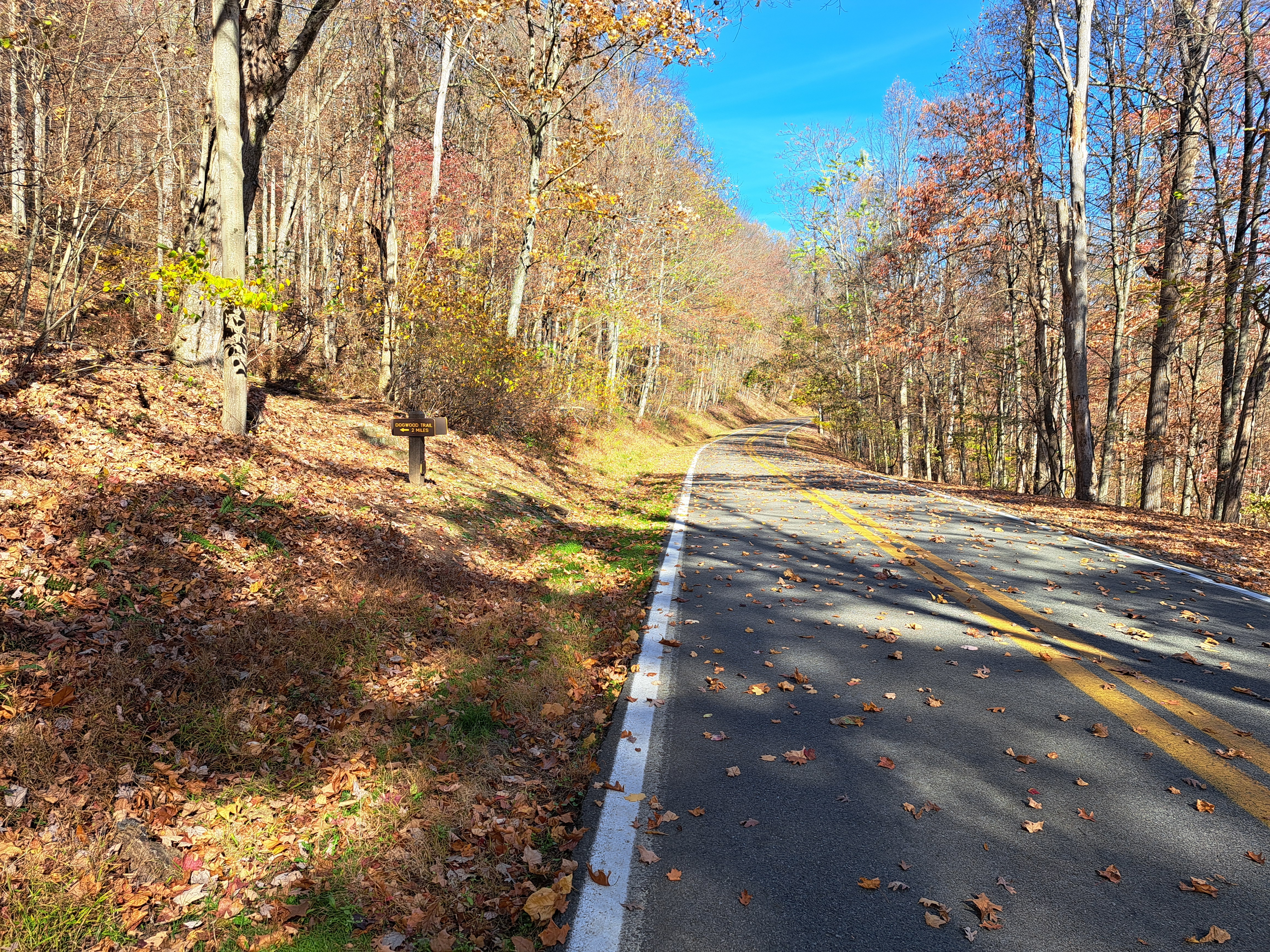
Signed start of Dogwood Trail
    
        Your first task on this hike is to find the start of the Dogwood Trail.  From the lodge parking lot, walk north on the seldom-used park road, which is back out the way you drove in if you followed the directions to the trailhead above.  After walking about 1000 feet, look for the signed start of the Dogwood Trail on the left.  The trail going right is the end of the Tygart Dam Trail, which is the final leg on our loop.
Climbing on the Dogwood Trail
    
        Marked with white plastic diamonds, the Dogwood Trail climbs the unnamed hill on a moderate to steep grade.  Three switchbacks get you to the top of the hill, and while the trail is rough and primitive, I have certainly hiked rougher and more primitive trails in West Virginia.  Some large oak trees dominate the forest, and the hiking is challenging but pleasant.
View down power line corridor
    
        At 0.7 miles, you reach the top of the hill as the trail curves left to pass under a power line.  A nice view northwest down the power line corridor 
can be had to the right.  This hilltop is about 400 feet above Tygart Lake, but Tygart Lake is not visible from here.  After reentering the woods, the trail makes a broad switchback near the top of the hill, and this switchback is the flattest part of the Dogwood Trail.
End of Dogwood Trail
    
        Just past 1 mile, the trail curves left to leave the hilltop area and heads straight down the hillside.  There are no switchbacks on this part of the trail, and therefore the descent is very steep.  At 1.2 miles, you intersect a steep gravel road that allows service vehicles to access some tanks to the right.  Turn left to walk down the gravel road and intersect the main park road.  A small alternate parking lot exists here, and the Dogwood Trail ends here.  A connector trail heads straight downhill to the Tygart Dam Trail, but this hike also visits Tygart Dam by turning right and beginning a 0.25 mile road walk.
Tygart Lake
    
        1.5 miles into the hike, you reach the Tygart Dam area, where a rustic picnic shelter overlooks the dam.  Turn sharply left to begin our return route on the Tygart Dam Trail.  Marked with yellow/orange trail markers, the Tygart Dam Trail descends steeply on a gated asphalt road to reach an area with benches overlooking Tygart Lake.  These benches feature nice views of Tygart Lake, and they make nice places to stop and have a snack with the hardest hiking behind you.
Looking uphill to the lodge
    
        At 1.7 miles, you reach a cul de sac where the gated road turns into a dirt trail.  After crossing a wooden footbridge, the connector trail you passed at the parking lot earlier comes in from the left.  The Tygart Dam Trail stays in the narrow strip of woods with the park road uphill to the left and the lake downhill to the right.  While the trail is not completely flat, it seems easy relative to the steep Dogwood Trail you hiked earlier.  At 2.2 miles, the lodge comes into view uphill to the left, and your final lake view opens up on the right.  Climb the steps to the left and walk through the lodge lobby to return to the lodge parking lot and complete the hike.

Monday, January 8, 2024

Point Pleasant Riverfront Park to Tu-Endie-Wei State Park (Blog Hike #981)

Trails: (unnamed)
Hike Location: Riverfront Park and Tu-Endie-Wei State Park
Geographic Location: Point Pleasant, WV (38.84250, -82.13919)
Length: 0.7 miles
Difficulty: 0/10 (Easy)
Date Hiked: October 2023
Overview: A flat hike, mostly on paved trail, along the Ohio River to the Point Pleasant Monument.
Park Information: https://wvstateparks.com/park/tu-endie-wei-state-park/
Hike Route Map: https://www.mappedometer.com/?maproute=950002
Photo Highlight:
Hike Video: 

Directions to the trailhead: This hike starts at the Riverfront Park floodwall door in downtown Point Pleasant.  Park in the perpendicular parking on the north side of the town's post office.

The hike: When most people think of American wars during the 1770's, the Revolutionary War is the first one to come to mind.  Yet while revolution against the British was fomenting in America's eastern cities of Boston and Philadelphia, another war was taking place on what was then America's northwestern frontier.  Named for the Royal Governor of the Virginia Colony, Lord Dunmore's War came about when forces under Shawnee Chief Cornstalk tried to stop the advance of American/British settlers in the Ohio valley.
            Lord Dunmore's War had only one major battle, namely the Battle of Point Pleasant in present-day West Virginia on October 10, 1774.  Though he was outnumbered at least 2 to 1, Chief Cornstalk advanced south to attack the Virginia militia under the command of Colonel Andrew Lewis.  Cornstalk's goal was to prevent the militia from crossing the Ohio River into present-day Ohio, thereby protecting Shawnee land along the river.  Fighting lasted all day, but the Shawnee were eventually outflanked and forced to retreat north across the river.  Later that month, Lord Dunmore led the Virginia militia deep into present-day Ohio, thus forcing the Shawnee to sign the Treaty of Camp Charlotte to end the war and surrender land claims south of the Ohio River.
            Today the Battle of Point Pleasant is commemorated by Tu-Endie-Wei State Park, a tiny 4 acre park in downtown Point Pleasant at the confluence of the Kanawha and Ohio Rivers.  The park's name comes from the Wyandot word that translates to "point between two waters," a reference to the park's confluential location.  The park's main structure is the Mansion House, a wooden structure dating to 1796 that was originally a tavern.  The City of Point Pleasant's Riverfront Park is only a short distance away, and walking the asphalt trail that joins the two parks forms the super short and super easy "hike" described here.
Point Pleasant floodwall
Riverfront Park
    
        Start by walking through the floodwall door, which brings you to the top of the amphitheater at Riverfront Park.  The amphitheater's stage is right by the Ohio River, and the "seats" are formed by a tiered wavy concrete structure.  The amphitheater looks like a small version of Cincinnati's famous Serpentine Wall, and the Ohio River bridges visible in either direction add to the scenery.
Entering Tu-Endie-Wei State Park
    
        To head for Tu-Endie-Wei State Park, turn left and begin walking downstream with the Ohio River on your right and the floodwall on your left.  A beautiful mural of pioneer life in this area adorns the floodwall, and metal statues of famous people from the pioneer era such as Sacagawea and Mad Anne Bailey line the asphalt trail.  At 0.25 miles, the asphalt trail ends where a sign welcomes you to Tu-Endie-Wei State Park.  Continue straight to walk across the mowed grass and enter the state park.
Point Pleasant Monument
Confluence of Ohio and Kanawha Rivers
    
        The state park occupies only about a city block, but there is lots to see here.  In addition to the aforementioned Mansion House, separate monuments stand to Shawnee leader Chief Cornstalk and The Magazine, where several members of the Virginia Militia are buried.  The tallest monument is the Point Pleasant Monument, a stone obelisk that stands to the battle itself.  Walking to the other (south) end of the park brings you to the confluence of the Ohio and Kanawha Rivers and allows you to see river bridges on both rivers.  After exploring the park, retrace your steps back to Riverfront Park and the floodwall door to complete the hike.

Thursday, December 28, 2023

North Bend State Park: Hibbs Cemetery and Nature Trails (Blog Hike #977)

Trails: Hibbs Cemetery and Nature Trails
Hike Location: North Bend State Park
Geographic Location: east of Parkersburg, WV (39.22497, -81.10469)
Length: 3.7 miles
Difficulty: 8/10 (Moderate/Difficult)
Date Hiked: October 2023
Overview: A loop hike over hills and along the North Fork of the Hughes River.
Park Information: https://wvstateparks.com/park/north-bend-state-park/
Hike Route Map: https://www.mappedometer.com/?maproute=949744
Photo Highlight:
Hike Video: 

Directions to the trailhead: In northern West Virginia, take I-77 to US 50 (exit 179).  Exit and go east on US 50.  Drive US 50 east 18 miles to SR 31 and turn right on SR 31.  Drive SR 31 south 5 miles, passing through the town of Cairo along the way, to Low Gap Road.  Turn left on Low Gap Rd.  Low Gap Rd. deadends at a 4-way stop at the park entrance in 3.3 miles.  Continue straight to enter the park, then drive the main park road 1.2 miles downhill to the River View Campground, where this hike begins.

The hike: Most state parks located on shores of man-made reservoirs were built at the same time as their lakes, but such is not the case with North Bend State Park.  The park dates to 1951, when the West Virginia State Legislature authorized the purchase of 1405 acres of depleted oil and natural gas fields.  The park opened a few years later, but North Bend Lake was not built until 2002.  The plain-looking concrete dam that forms the lake can be seen in the eastern end of the park today.
            In addition to aquatic activities on the lake, the park offers a cozy 29-room lodge, a 49-site developed campground, a swimming pool, a picnic area, and access to the North Bend Rail Trail, a 74-mile bike trail built atop an abandoned railroad grade.  The park also offers several miles of hiking and mountain bike trails in a part of West Virginia with few quality hiking options.  Most people view the park's Nature Trail as its best trail, and this hike combines the Nature Trail with one of its spurs to form a challenging and primitive 3.7 mile loop.  Be warned that many parts of this trail are hard to discern on the ground, so do not attempt this hike without a park trail map and good route-finding skills.
Start of Hibbs Cemetery Trail
    
        This hike starts on the Hibbs Cemetery Trail, which begins at a small wooden sign behind the River View Campground check-in building.  The Hibbs Cemetery Trail is marked with blue plastic diamonds, and it begins climbing a narrow finger ridge on a moderate to steep grade.  This finger ridge separates the developed and primitive parts of the River View Campground, so camping areas exist downhill on both sides of this ridge.
Boulders along Hibbs Cemetery Trail
    
        The trail stays near the top of the ridge as it passes some large boulders and rock outcrops.  The trail map indicates that Hibbs Cemetery sits in this area, but I either could not find it or walked past it unawares.  At 0.5 miles, you reach a trail intersection as the park's lodge comes into sight on the right.  The Hibbs Cemetery Trail ends here.  To continue this hike, turn left and cross over a small hill to reach the 
4-way stop road intersection at the park entrance; you drove through this intersection on the way in.  Walk diagonally across the intersection to pick up the Nature Trail, which you will follow for the rest of this hike.
Joining the Nature Trail
    
        Marked with orange plastic diamonds, the Nature Trail heads into a narrow strip of woods with park roads above you to the left and below you to the right.  When I hiked here, the Nature Trail as shown in the park map was overgrown and practically impassible, so I ended up hiking an unmarked and unofficial trail that stays well below the top of the ridge.  This choice reduced the length and elevation gain of this hike, but I rejoined the Nature Trail at 1.2 miles into my hike.  I have learned over the years that trail maintenance can be an issue in West Virginia's state parks, and this is one place where that issue comes to the forefront.
Hiking the Nature Trail
    
        A moderate to steep downgrade brings you to a park road crossing at 1.4 miles.  Next comes a surprisingly flat section of trail that treads through nice forest as you partially circle a low knob on the left.  Beech and maple are the most common trees in this forest, and this section of trail is really quite pleasant.
Grassy area along river
    
        Just shy of 2 miles into the hike, the flat section ends as you begin a steep switchbacking descent to the North Fork Hughes River.  This section of trail has recently been rerouted, and orange plastic diamonds seem to be everywhere here.  You cross a tiny stream without the aid of a bridge before finally making it to the river bank at 2.4 miles.  The riverside area has a thick grassy groundcover, and you will have to rely on the orange plastic diamonds to stay on the trail: it is indistinguishable from the surrounding forest in this area.
North Fork Hughes River
    
        The scenic riverside area lasts only a few hundred feet before you begin the steep climb away from the river.  Ignore the Tanker Run Spur Trail, which exits right, and keep following the orange plastic diamonds to remain on the Nature Trail.  At 2.65 miles, you reach picnic shelter #1 at the top of the ridge.  Restrooms are available here, and this shelter makes a nice place to rest and enjoy a trail snack before beginning the final leg of the hike.
Picnic Shelter #1
    
        Next the trail passes through a steep and narrow ravine to reach picnic shelter #2.  Another steep descent on narrow trail drops you below the rock cliffs and returns you to the river at 3 miles.  Some Canada geese greeted me along this section of the river.
Hiking along the river
    
        The balance of the hike uses narrow trail that treads sometimes near the river and sometimes along the bluff high above the river.  A couple parts of this trail cling perilously to the hillside.  A final switchback brings you down to the primitive campground, where a left turn on the park road will bring you back to the campground check-in station to complete the hike.


Monday, December 19, 2022

North Bend Rail Trail: Cairo to Silver Run Tunnel (Blog Hike #920)

Trail: North Bend Rail Trail
Hike Location: North Bend Rail Trail
Geographic Location: east of Parkersburg, WV (39.20856, -81.15603)
Length: 6.4 miles
Difficulty: 3/10 (Easy/Moderate)
Date Hiked: October 2022
Overview: An out-and-back on gravel rail-trail to a supposedly haunted old railroad tunnel.
Trail Information: https://wvstateparks.com/park/north-bend-rail-trail/
Hike Route Map: https://www.mappedometer.com/?maproute=924770
Photo Highlight:
Hike Video:

Directions to the trailhead: From Parkersburg, take US 50 east 18 miles to SR 31 and turn right on SR 31.  Drive SR 31 south 4.2 miles to the town of Cairo.  Park at the perpendicular street parking in downtown Cairo.

The hike: With a current population of 174, Cairo, WV is one of those kind of creepy two-thirds abandoned industrial towns that are scattered throughout West Virginia and more generally throughout Appalachia.  During the town's hay day in the early 1900's, over 650 people lived here.  Early settlers were attracted to this site by the fertile land and the abundant water provided by the North Fork of the Hughes River, which runs through town.  Later lumber and coal dominated the area, and the town's population declined along with these industries.
            Glimpses of Cairo's glory days remain, and they include the North Bend Rail Trail, which follows a former spur of the famous Baltimore & Ohio (B&O) Railroad.  Another remnant of this town's industrial past is the the two-story brick building that formerly housed the Bank of Cairo.  Built in 1897, that building is listed on the National Register of Historic Places, and it presently serves as the town's City Hall.
            The North Bend Rail Trail is regarded as one of the best bike paths in Appalachia, and it is famous for its long tunnels and mountainous scenery.  The hike described here starts in downtown Cairo and heads west on the rail trail to a particularly famous tunnel: the 1376-foot long Silver Run Tunnel.  Not only is the tunnel an impressive construction, but it is supposedly haunted by a young ghostly woman who was seen by several railroad engineers when the railroad was operating in the early 1900's.  Honestly, even though I did this hike on a cloudy damp Halloween afternoon when dense fog made the tunnel an eerie setting, I did not observe anything paranormal during my hike.
North Bend Rail Trail's Cairo trailhead
    
        From downtown Cairo, head west on the North Bend Rail Trail as it crosses the North Fork of the Hughes River on an old railroad bridge.  This bridge has been repurposed with a wooden deck to support hikers, bikers, and horses, and strategically placed boulders block vehicle access.  The historic Bank of Cairo building stands to the left here, as do an old black bell and some smaller brick buildings.
Historic Bank of Cairo building
    
        The gravel rail trail heads west with the hillside rising to your right and houses on CR 31/4 downhill to your left.  Because this route was built for trains, the grade is very gradual.  Nevertheless, you gain about 200 vertical feet of elevation between downtown Cairo and the Silver Run Tunnel.  Where steep driveways exit right or left, choose the more gradual gravel trail to remain on the North Bend Rail Trail.  Mile markers appear at 1 mile increments and help you track your progress.
Picnic table beside the trail
    
        Near 1.5 miles into the hike, you pass a picnic table that makes a nice place to rest about halfway to the tunnel.  Tall rock outcrops, probably exposed during the railroad's construction, tower over the trail to the right here.  Other subtle reminders of this trail's railroad past such as wooden posts and ties can be seen occasionally if you look carefully.  Also, CR 31/4 often stays in sight downhill to the left even though houses become fewer and further between.  The forest here is a nice mixture of pine and broadleaf trees.
Rock outcrops towering over trail
    
        At 2.6 miles, you cross gravel CR 31/4 near where it intersects CR 18/2.  The surrounding hills grow taller now, and soon the trail enters the deep rock cut that leads to Silver Run Tunnel.  At 2.9 miles, you reach the tunnel's east portal.  This long tunnel has a curve, so you can't see the other end of the tunnel from here.  Thus, a flashlight is highly recommended if you want to enter the tunnel.
East portal of Silver Run Tunnel
    
        Once you enter the tunnel, the cool subterranean air causes the warmer moister air from outside the tunnel to condense, forming fog.  Also, the brick walls cause sound to reverberate in odd ways.  Thus, I found the tunnel rather eerie even though I did not see anything paranormal while walking through the tunnel.  The rail trail continues another 23 miles to the west, but the tunnel is a good place to turn around.  Retracing your steps back to Cairo completes the hike.

Tuesday, July 7, 2020

Droop Mountain Battlefield State Park (Blog Hike #801)

Trails: Overlook, Horse Heaven, Cranberry Bogs, and Musket Trails
Hike Location: Droop Mountain Battlefield State Park
Geographic Location: southwest of Marlinton, WV (38.11568, -80.26875)
Length: 2 miles
Difficulty: 3/10 (Easy/Moderate)
Date Hiked: June 2020
Overview: A loop hike around the Civil War battlefield that secured West Virginia for the Union.
Park Information: https://wvstateparks.com/park/droop-mountain-battlefield-state-park/
Hike Route Map: https://www.mappedometer.com/?maproute=817026
Photo Highlight:
Hike Video: 

Directions to the trailhead: Droop Mountain Battlefield State Park is located on the west side of US 219 15.3 miles south of Marlinton or 26.5 miles north of Lewisburg.  Enter at the main park entrance, then turn right to follow signs for the museum and park office.  Park in the parking lot in front of the park office.

The hike: The Battle of Droop Mountain on November 6, 1863 was one of the largest Civil War engagements in West Virginia.  Union troops under the command of Brigadier General W.W. Averell and Colonel Thomas Harris were moving south toward the Confederate stronghold of Lewisburg with the ultimate goal of disrupting railroad traffic on the Virginia & Tennessee Railroad further south.  Confederate forces under the command of Brigadier Generals John Echols and Albert Jenkins knew that the Union troops would have to come over Droop Mountain in order to reach Lewisburg.  Moreover, Droop Mountain's high relief offered the Confederates their best chance to mount a strong defense.
            The Confederates were outnumbered more than 3 to 1, but occupying the high ground, significant artillery, and constructed fortifications allowed them to repel Union advances in the morning.  By the early afternoon, Averell outflanked the Confederates on their left, and the Confederates fled in a disorganized retreat after a brief but violent battle.  All tallied, the Confederates took 275 casualties and lost large quantities of arms and ammunition.  Union forces took Lewisburg the next day, and the Battle of Droop Mountain marked the end of organized Confederate resistance and operations in West Virginia.
            Due to the efforts of West Virginia House of Delegates' John D. Sutton, a Private in the Union army during the battle, today 287-acre Droop Mountain Battlefield State Park preserves the battle's site.  The park was dedicated on July 4, 1928 as West Virginia's first state park.  The park offers only a lookout tower, a playground, a small museum, some picnic shelters, and some hiking trails for amenities, so history and nature take center stage here.  The hike described here is not the park's longest possible hiking route, but it passes the main historic sites and amenities, thus offering a good overview of the park.
Trailhead for Overlook Trail
    
        Start at the north end of the parking area where a sign marks the start of the Overlook Trail; a large interpretive sign describing the white oak tree also stands here.  None of this park's trails are marked except at trailheads and intersections, but I found most of the trails easy to follow on my visit.  The Overlook Trail curves left and arrives at some trenches dug and occupied by Confederate forces.  Some interpretive signs tell you that these trenches are located near the area where the Confederates got outflanked.  Imagine what it would be like to hunker down in this trench with an army three times the size of yours advancing on your position.
Confederate trench
    
        The trail continues curving left, and at 0.2 miles you reach a northwest-facing overlook platform.  Droop Mountain is one of several mountains of similar height in this area, and Round Mountain stands in full view across the valley to the northwest.  A small cave called Old Bear Den is also located in this area, and the rugged Big Spring Trail leads downhill to its namesake spring.  Head south from the overlook to continue the Overlook Trail.
View northwest from Droop Mountain
    
        After passing some rock outcrops bordered by rhododendron, you reach the end of the Overlook Trail at an intersection with the Horse Heaven Trail.  Turn right to begin heading south on the Horse Heaven Trail.  The Horse Heaven Trail is the most primitive trail used by this hike, and it was somewhat overgrown and hard to follow on my visit.  The Horse Heaven Trail parallels the park road, so you can cut through the woods to the left and walk on the park road if trail conditions are too bad.
Hiking the Cranberry Bogs Trail
    
        At 0.75 miles, you reach the south end of the Horse Heaven Trail at a combined road and trail intersection.  To continue this hike, turn left and cross the road to pick up the Cranberry Bogs Trail.  The wide dirt Cranberry Bogs Trail descends gradually on a southeastward course through a dark forest dominated by spruce and hemlock trees.  Some mountain laurel in bloom brightened my path on my mid-June visit.
Cranberry bogs
    
        Ignore the Old Soldier Trail and continue to follow the Cranberry Bogs Trail as it passes its namesake wetland.  The cranberry bogs were actually fairly dry on my visit, and I saw more ferns than cranberries in this "bog."  Past the bogs, walk through a complicated trail intersection to reach an old stone trail shelter located beside the park road.  Angle left and walk up the paved spur road that leads to the park's famous lookout tower.  Steps lead to the top of the wooden lookout tower, which offers fantastic views east across the Greenbrier River valley and into the wooded hills of vast Watoga State Park.  Some picnic tables near the lookout tower beckon you to sit, rest, and take in the view.
View east from lookout tower

Lookout tower
    
        Two trails exit the lookout tower area: the Musket Trail and the Minnie Ball Trail.  Both trails lead in the general direction of your car and the park office, but this hike uses the easier, flatter, and better-maintained Musket Trail as its final leg.  The Musket Trail descends to cross the main park road only to curve right and intersect the road again at the lowest elevation of this hike.  Rather than crossing the road, the trail curves left and climbs moderately to reach the Musket Trail's north end at an intersection with the Cranberry Bogs Trail.  Turn right and hike the short final segment of the Cranberry Bogs Trail to return to the park office and complete the hike.

Saturday, July 4, 2020

Monongahela National Forest: Seneca Rocks Trail (Blog Hike #800)

Trail: Seneca Rocks Trail
Hike Location: Monongahela National Forest, Seneca Rocks National Recreation Area

Geographic Location: east of Elkins, WV (38.83414, -79.37630)
Length: 3.6 miles
Difficulty: 8/10 (Difficult)
Date Hiked: June 2020
Overview: A steep climb on well-constructed gravel trail featuring views of and from Seneca Rocks.
Area Information: https://www.fs.usda.gov/recarea/mnf/recreation/hiking/recarea/?recid=7051&actid=50
Hike Route Map: https://www.mappedometer.com/?maproute=817020
Photo Highlight:
Hike Video: 

Directions to the trailhead: From Elkins, take US 33 east 35 miles to its intersection with SR 28 in the town of Seneca Rocks.  Turn right at this intersection, and then 500 feet later turn left to enter the parking area for the Seneca Rocks Discovery Center, which is the trailhead for this hike.  Park in the lower parking area, which was the only parking area open on my visit.

The hike: Jutting more than 800 feet above the South Branch of the Potomac River, Seneca Rocks may be the most recognizable natural landmark in all of West Virginia.  The rocks are made of white/gray Tuscarora quartz, so they have a distinct bright appearance compared to the darker sandstone that underlies much of this region.  Sandstone is more easily eroded than quartz, which explains why the exposed quartz stands at the top of the ridge: the surrounding sandstone got eroded away.
            Seneca Rocks have been a local landmark for centuries, and the construction of the Seneca Rocks Discovery Center in 1998 unearthed evidence of two ancient villages.  Moreover, the ancient Seneca Trail, a road connecting the Algonquin, Tuscarora, and Seneca nations, passed the base of the rocks as it followed the Potomac River.  The Seneca Rocks Discovery Center is located near this trailhead, and it offers interesting exhibits on the area's geologic and human history.  Unfortunately, the Discovery Center was closed due to the Covid-19 pandemic on my visit.
            Today Seneca Rocks is the centerpiece of the Seneca Rocks National Recreation Area, which in turn is part of eastern West Virginia's 921,000 acre Monongahela National Forest.  Seneca Rocks is a major destination for rock climbers, but hikers can also explore the rocks by hiking the 3-mile round-trip Seneca Rocks Trail.  Combining the Seneca Rocks Trail with a short, flat journey past the Seneca Rocks Discovery Center forms the 3.6 mile out-and-back hike described here.
Trailhead at lower parking area
        From the lower trailhead parking area, start by taking the black cinder path that heads north, passing an information board.  Your first view of Seneca Rocks appears across the meadow to your right, and ascending to the back porch of the Seneca Rocks Discovery Center gives the best valley-level view of this natural monument.  Continue north across a long boardwalk/bridge that carries you over Seneca Creek.  The area's waterways were raging on my visit from heavy rains earlier in the morning, and I appreciated the well-built bridges that got me across Seneca Creek and later the Potomac River safely.
Valley view of Seneca Rocks
    
Sites Homestead

South Branch of Potomac River
    
        The wide gravel Seneca Rocks Trail leaves the east side of the picnic area parking lot and passes another information board before crossing the South Branch of the Potomac River on another long bridge.  Where the spur trail to Roy Gap Road exits right, turn left to begin the climb up to Seneca Rocks in earnest.  The climb to Seneca Rocks gains 800 vertical feet over 1.5 miles on a persistent grade.  While the climb takes some effort, five switchbacks and the improved gravel trail surface make it doable for most people.  Some interpretive signs provide good information about Seneca Rocks and offer additional incentive to stop and catch your breath on the climb up.
Climbing some wooden stairs
    
        0.8 miles into the hike, you reach the steepest part of the climb, which is negotiated by some constructed wooden stairs with a hand railing.  At the third switchback, you pass a wooden bench that is this hike's only opportunity to sit and rest.  I had driven to the trailhead in a steady rain, but as I topped the fifth and last switchback, the sun broke through the clouds for the first time in the four days I had been in West Virginia.
Still climbing
    
        At 1.8 miles, you reach the wooden observation platform located beside Seneca Rocks.  From this west-facing lookout, the town of Seneca Rocks lies directly below, and waves of ridges headed by Smith Mountain on the right and Kisamore Hill on the left roll off in the distance.  Some benches at the platform encourage you to sit, rest from your climb, have a trail snack, and take in the views.
View from Seneca Rocks
    
        Some hikers continue on an unofficial trail that leads out onto the sheer rocks, but the views do not get any better, and several people have fallen to their deaths while climbing on the rocks.  Thus, I turned around and retraced my steps downhill to the lower parking lot trailhead to complete my hike.  Right on cue, the rain began again exactly
 when I got back to parking lot.

Wednesday, July 1, 2020

Blackwater Falls State Park: Yellow Birch and Gentle Trails (Blog Hike #799)

Trails: Yellow Birch and Gentle Trails
Hike Location: Blackwater Falls State Park

Geographic Location: southwest of Davis, WV (39.10767, -79.49561)
Length: 3.7 miles
Difficulty: 5/10 (Moderate)
Date Hiked: June 2020
Overview: The back road to fantastic Blackwater Falls.
Park Information: https://wvstateparks.com/park/blackwater-falls-state-park/
Hike Route Map: https://www.mappedometer.com/?maproute=817014
Photo Highlight:
Hike Video: 

Directions to the trailhead: From Davis, take Blackwater Falls Road west 1.2 miles to the major road intersection at the entrance to Blackwater Falls State Park.  Signs direct you to continue straight to reach the falls, but to reach this trailhead turn left to follow signs for the lodge, which is reached in another 1.6 miles.  Park in the large lot in front of the lodge.

The hike: Established in 1937 as one of West Virginia's earliest state parks, 2358-acre Blackwater Falls State Park is one of the crown jewels in West Virginia's state park system.  The park is centered around 62-foot Blackwater Falls, a major waterfall on the Blackwater River's 34-mile westward journey from Canaan Mountain to the Black Fork of the Cheat River and ultimately to the Monongahela River.  The river and falls get their name from the water's tannin, which is produced by decaying spruce needles and other vegetation common in Canaan Valley, where the river originates.
            Blackwater Falls State Park offers many amenities, including a 54-room lodge, 39 cabins, a 65-site campground, and 20 miles of hiking trails.  Nevertheless, Blackwater Falls remains the park's main attraction, and the most popular way to see the falls is by descending the short series of wooden stairs on the falls' north side.  For hikers wanting to escape the crowded stairs or wanting a different view of the falls, the hike described here has appeal.  Rather than taking you to the base of the falls from the north, this hike uses lightly-trafficked trails from the south to reach an ADA-accessible overlook high above the falls.  Thus, it makes a nice alternative to the more traditional and touristy falls-viewing option.
West end of Yellow Birch Trail, near lodge
    
        From the lodge parking lot, walk back out to the main park road and then find the signed start of the Yellow Birch Trail, which is located on the south side of the main park road between the two entrances to the lodge parking lot.  Marked with yellow aluminum squares, the Yellow Birch Trail embarks on an eastbound course over rocky, rooty, and wet terrain that parallels the main park road.  Despite the rough and primitive trail surface, traffic noise from the nearby park road prevents this hike from taking on a secluded backcountry feel.
Hiking the Yellow Birch Trail
            At 0.8 miles, the trail passes through a bouldery area that forces you to either boulder scramble or wiggle through a fat-man's-squeeze.  Next a steep descent carries the trail across the paved road that leads to the park's petting zoo and down to a creek that must be rock-hopped.  After crossing the creek, you rise to reach an intersection with the Davis Trail, which goes left and right.  Continue straight to remain on the Yellow Birch Trail.  The 184-mile Allegheny Trail joins our route here, and turning right would lead south several miles on the Allegheny Trail to Canaan Valley Resort State Park, which was featured in the previous hike.
A small wet meadow
    
        The trail goes up and over another low ridge, and at 1.5 miles it traces the edge of a small wet meadow.  A boardwalk and some gravel keep your feet dry near the meadow.  Some mountain laurel was in bloom when I hiked here in mid-June, and despite the trail's name the forest here contains more spruce and hemlock trees than yellow birch trees.
Gentle Trail, approaching the overlook
    
        1.8 miles into the hike, you reach a maintenance area road that marks the east end of the Yellow Birch Trail.  Turn left to walk out to the main park road, and then turn left again to find the trailhead parking for the ADA-accessible Gentle Trail.  The asphalt Gentle Trail reaches the ADA-accessible Blackwater Falls overlook at its end in only another 500 feet.  The water tumbling over sandstone is an impressive sight.  The Blackwater River provides plenty of water to fall, and the boulder-filled canyon combines with the spruce-covered surrounding slopes to make a colorful setting.  Some benches near the overlook provide great places to rest and enjoy the area.
Blackwater Falls, from ADA-accessible overlook

Blackwater Falls, from base-level overlook
    
        F
rom this perch high above the river, you can see the wooden overlook platforms on the other side of the river at the base of the falls, but there is no way to get there from here via trail.  Thus, the best option is to turn around and retrace your steps to the lodge to complete the hike.  While you are at the lodge, the area behind the lodge is an overlook area that provides fantastic views of the Blackwater River's canyon below the falls.  Of course, the touristy falls access on the river's north side is worth a visit on your way out as well.
Canyon below Blackwater Falls