Showing posts with label Georgia Hikes. Show all posts

Monday, July 14, 2025

Chattahoochee National Forest: DeSoto Falls Recreation Area (Blog Hike #1071)

Trail: DeSoto Falls Trail
Hike Location: Chattahoochee National Forest, DeSoto Falls Recreation Area
Geographic Location: north of Dahlonega, GA (34.70786, -83.91444)
Length: 2.2 miles
Difficulty: 4/10 (Moderate)
Date Hiked: May 2025
Overview: A double out-and-back to Lower and Upper DeSoto Falls.
Area Information: https://www.fs.usda.gov/r08/chattahoochee-oconee/recreation/desoto-falls-recreation-area
Hike Route Map: https://www.mappedometer.com/?maproute=989695
Photo Highlight:
Hike Video:

Directions to the trailhead: From Dahlonega, take US 19 north 17 miles to the signed entrance for DeSoto Falls Recreation Area on the left.  Take a soft left to enter the area, and then turn left into the day-use falls parking lot.  Park here.

The hike: The North Georgia Mountains contain a plethora of famous and scenic waterfalls.  Amicalola Falls impresses with its sheer height, Raven Cliff Falls impresses with its cliff-cutting action, and the waterfalls in Tallulah Gorge impress with their water volume.  Often overlooked among the region's waterfall options is DeSoto Falls, perhaps because of the more famous and identically named waterfall in nearby Alabama.  Yet anyone willing to come to Chattahoochee National Forest's DeSoto Falls Recreation Area after a good rain will find 1 nice waterfall and 1 show-stopping waterfall as scenic as any in the region.
            The DeSoto Falls Recreation Area protects 650 acres around its namesake waterfalls and along scenic Frogtown Creek.  The Recreation Area features a cozy 23-site campground in addition to some picnic tables and, of course, the trails to the waterfalls.  The area's trail system does not connect to any other trails, so waterfall enthusiasts will have it all to themselves.  The hike described here uses every trail in the Recreation Area, and it features both of the waterfalls the Recreation Area has to offer.
Trail leaves parking area
    
        Start at the big information board near the front of the day-use parking lot.  The wide dirt trail descends gradually on a broad switchback as it passes through the Recreation Area's picnic area.  Numerous picnic tables sit here, and several of them were in use on the warm and humid Tuesday afternoon that I came here.
Footbridge over Frogtown Creek
    
        After a few hundred feet, you reach the campground road.  Angle left to start walking along the paved campground road, then turn left to cross Frogtown Creek on a nice wooden footbridge.  Immediately after crossing the bridge, you reach a trail intersection with options going left and right.  Each of these two trails leads to a big waterfall, so we will go both ways eventually; t
he hike to Lower Falls is shorter but steeper than the hike to Upper Falls.  I turned left to head for Lower Falls first.
Frogtown Creek
    
        Next comes a short flat streamside section with Frogtown Creek on your left, but at 0.2 miles you begin climbing the 2 switchbacks that lead to the Lower Falls viewing platform.  At 0.4 miles, you reach the viewing platform for Lower Falls.  Lower Falls drops 30 feet via several cascades, and while it would be the main waterfall attraction on many hikes, it is actually the lesser of the 2 waterfalls on this hike.  Lower Falls had plenty of water volume when I came here right after several days of rain, but it can become a trickle during a drought.
Lower Falls
    
        The trail ends at Lower Falls, so next you have to turn around, retrace your steps to the main trail intersection at the footbridge, and then continue straight to begin heading for Upper Falls.  The next segment is a pleasant streamside hike through forest dominated by maple and oak trees with some dying pine trees.  The mountain laurel was in full bloom when I came here in mid-May; the rhododendron was at least a month away from blooming.  
Some poison ivy lives in the understory, but the trail is plenty wide to allow you to avoid it.  The campground is visible across the creek at first, and noisy US 19 can be heard everywhere on this hike except where it is drowned out by falling water.
Mountain laurel in bloom
    
        1.1 miles into the hike, the trail curves left to pass over a small hill.  A few lime green paint blazes mark the way, and you step over some wooden waterbars on this well-constructed trail.  At 1.3 miles, you reach the viewing platform for Upper Falls.
Upper Falls
    
        What a sight this waterfall is!  Water falls 120 feet in 4 distinct drops, but as with Lower Falls you have to come after a rain for Upper Falls to have enough water.  Upper Falls was fantastic when I came here, and it might be my second favorite waterfall in the North Georgia Mountains, behind Raven Cliff Falls.  The trail ends here, so your only option is to retrace your steps to the parking lot to complete the hike.


Tuesday, February 13, 2024

Chicopee Woods Nature Preserve: Bridge Loop in Gainesville, GA (Blog Hike #984)

Trails: Elachee Creek and Bridge Loops
Hike Location: Chicopee Woods Nature Preserve
Geographic Location: Gainesville, GA (34.24608, -83.83197)
Length: 3.1 miles
Difficulty: 5/10 (Moderate)
Date Hiked: January 2024
Overview: A lollipop loop crossing 5 trail bridges.
Park Information: https://www.gainesville.org/facilities/facility/details/Chicopee-Woods-Area-Park-118
Hike Route Map: https://www.mappedometer.com/?maproute=955192
Photo Highlight:
Hike Video:

Directions to the trailhead: Northeast of Atlanta, take I-985 to SR 13 (exit 17).  Exit and go north on SR 13.  Drive SR 13 north 1.5 miles to Elachee Drive and turn sharply right on Elachee Dr.  Elachee Dr. crosses back over I-985 before ending at the Elachee Nature Science Center, where this hike begins.

The hike: Sprawling for 2674 acres over the hills on the south side of Gainesville, Chicopee Woods is the crown jewel of Gainesville's city park system.  The park's most famous amenity is its 27 hole golf course, which is one of the best public courses in northeast Georgia.  Other than the golf course, the rest of the park is maintained as a natural area known as Chicopee Woods Nature Preserve, which features dense woods and abundant trails.  A new park entrance road was under construction when I came here, and that road will feature a new bridge over I-985 designed to highlight this park and the City of Gainesville's parklands.
            Over 12 miles of trails wind through Chicopee Woods Nature Preserve for hikers and mountain bikers (but usually not both: most trails are single-use).  The hiking trails are organized into loops of various lengths and difficulties; this hike features the Bridge Loop.  The Bridge Loop earns its name by crossing 5 wooden trail bridges, and it is neither the shortest and easiest nor the longest and hardest loop Chicopee Woods has to offer.  I did this hike as a get-back-in-shape hike after a long Christmas break, and it had enough distance and elevation to serve the purpose well.
Start of the Geiger Trail
    
        Starting from the Elachee Nature Science Center, which features several educational exhibits and classroom areas, your first task is to find the start of the Bridge Loop.  Near the parking lot entrance, walk down the concrete Geiger Trail to the dirt and yellow-blazed Elachee Creek Loop.  Angle right on the Elachee Creek Loop, and in about 700 feet you reach the green-blazed Bridge Loop.  A secondary parking area sits uphill to the right.  Continue straight to begin following the green blazes, then angle first right and then left to begin hiking clockwise around the Bridge Loop.
Intersecting the Bridge Loop
    
        The trail descends on a gradual to moderate grade as you head out one of this area's many finger ridges.  Distance is marked by brown carsonite posts in 0.25 mile increments.  This park's
 deciduous forest makes for good fall leaf peeping, and some large beech trees merit your attention as you descend.  At 0.5 miles, you reach a junction with the blue-blazed Ridge Trail, which continues straight.  Turn right to keep descending on the Bridge Loop.
First bridge over Walnut Creek
    
        0.8 miles into the hike, you reach Walnut Creek and the bottom of the hill.  The first of the 5 bridges, a narrow wooden bridge with nice handrails, gets you across the creek.  A broad switchback lifts you to the top of the next ridge, which stands about 170 feet above the creek.  Ignore some old dirt roads that now serve as park maintenance roads; white carsonite posts identify them as service roads.
Descending on eroded trail
    
        At 1.3 miles, you reach some picnic tables and another major trail intersection.  The orange-blazed Lake Loop exits left to head downhill to Chicopee Lake, but you want to angle right to head downhill on a trail used by both the Bridge and Lake Loops.  0.3 miles of moderate downhill hiking on somewhat eroded trail brings you to your second crossing of Walnut Creek.  This time a 141-foot suspension bridge gets you across the creek, and this second bridge on the Bridge Loop is this park's biggest and best trail bridge.
Suspension bridge over Walnut Creek
    
        Now on the west side of Walnut Creek, the Bridge and Lake Loops part ways.  Turn right to stay on the Bridge Loop.  Next you cross a low but steep ridge before beginning a gradual creekside climb for the next 0.7 miles.  You climb first along Walnut Creek, then along Vulture Rock Creek, then along Homestead Creek.  Just before the bridge over Vulture Rock Creek, you pass an interesting old concrete dam that today forms a nice waterfall.
Old concrete dam
    
        Ignore the pink-blazed Upland Trail that exits right before you cross the final 2 bridges, both simple wooden bridges over Homestead Creek.  Just past 2.5 miles, the fuchsia-blazed Chicopee Backcountry Trail, this park's longest and hardest trail, exits left.  Another pair of picnic tables here makes a nice creekside spot to rest before tackling the final climb of the hike.
Final trail bridge
    
        The climb away from Homestead Creek is the steepest and muddiest part of this loop, but it only gains about 100 vertical feet of elevation.  At 2.8 miles, you reach the secondary parking area, where you need to turn right to hike a short connector trail down to the outbound portion of the Bridge Loop, thus closing the loop.  Turn left and retrace your steps back to the Elachee Nature Science Center to finish the hike.

Monday, July 17, 2023

Red Top Mountain State Park: Iron Hill Trail (Blog Hike #954)

Trail: Iron Hill Trail
Hike Location: Red Top Mountain State Park
Geographic Location: east of Cartersville, GA (34.14004, -84.69901)
Length: 3.6 miles
Difficulty: 4/10 (Easy/Moderate)
Date Hiked: May 2023
Overview: A loop hike along Lake Allatoona passing an old iron mining community.
Park Information: https://gastateparks.org/RedTopMountain
Hike Route Map: https://www.mappedometer.com/?maproute=936837
Photo Highlight:
Hike Video:

Directions to the trailheadNorthwest of Atlanta, take I-75 to Red Top Mountain Road (exit 285).  Exit and go east on Red Top Mountain Rd.  Drive Red Top Mountain Rd. east 3.2 miles, crossing Lake Allatoona and passing the park's Trading Post in the process, to the signed trailhead parking for the Iron Hill Trail on the right.  Pay the entrance fee and park in the large gravel parking lot.

The hike: For my general comments on Red Top Mountain State Park, see my blog entry for the Homestead Trail, which is this park's signature trail.  This park and mountain are named for the high iron content in this area's soil.  Iron was mined here during the 1800's, and the Iron Hill Trail takes you through one of the old iron mining communities.  While little of the former community remains, the wide trail on gradual grades makes for easy hiking, and this park's location on the fringe of metro Atlanta means this trail gets plenty of use.  Try to plan a weekday visit in the winter for best hiking conditions and maximum solitude.
Trailhead at rear of parking lot
    
        From the rear of the large gravel parking lot, follow signs for the trailhead, which means heading down a two-track gravel road and then turning left.  A slight descent brings you to an intersection with the Iron Hill Trail, which goes left and right.  I chose to turn left and use the trail going right as my return route, thus hiking the loop clockwise.  The Iron Hill Trail is marked with blue trail markers, but the trail is wide and obvious for its entire distance.
Starting the Iron Hill loop
    
        Soon the parking lot comes into view uphill and to the left, and a highly eroded now-closed trail going up to the parking lot shows you why the initial turns/route were necessary.  The wide gravel trail descends gradually and crosses a gated park maintenance road at 0.25 miles.  More gradual descending brings you to the base of a highly eroded hillside at 0.5 miles.  Although no signs indicate such, this appears to be the site of the old iron mine: the steep exposed dirt and rock here look anything but natural.  Fittingly, a black vulture looked down on me here, and it is fun to imagine what this site might have been like when the mine was active.
Old ironing site
    
        Continuing around the loop, soon Lake Allatoona comes in sight to the left, and partially obstructed views of the lake will keep you company for most of the rest of the hike.  Small wooden distance markers appear in 0.5-mile increments.  At 0.9 miles, the trail curves sharply left to follow the park maintenance road for a short distance before resuming its wide gravel character again.
1.5-mile marker
    
        Next comes my favorite part of the hike: the trail winds its way uphill to cross a narrow peninsula that juts west into Lake Allatoona.  Plenty of benches provide ample opportunities to sit and rest 
in the nice mixed deciduous forest, which makes this hike bearable even on a warm day.  Now on the north side of the peninsula, more winding brings you to where the trail appears to join an old road at 2.6 miles.  Just past this point is a side trail that exits left to this hike's best Lake Allatoona view.  Some old partially broken concrete picnic tables stand here, adding to the historic flavor of this hike.
Lake Allatoona
    
        Near 3 miles, a pair of side trails exits right.  The first side trail leads to the old maintenance road, while the second side trail provides a small short-cut for this hike.  Stay left both times to remain on the official Iron Hill Trail.
Climbing back to the trailhead
    
        After passing a final lake view and a short wooden boardwalk, the trail climbs away from the lake.  Only about 50 feet of elevation is gained, and the climb is really quite easy.  At the top of the hill is another trail intersection.  The trail going right is the small short-cut you passed earlier, and the trail going left leads to the park's main campground.  Continue straight to close the loop in less than 0.2 miles.  Turn left to return to the parking lot and complete the hike.

Tuesday, July 11, 2023

Cloudland Canyon State Park: Waterfalls Trail (Blog Hike #953)

Trail: Waterfalls Trail
Hike Location: Cloudland Canyon State Park
Geographic Location: east of Trenton, GA (34.83562, -85.47959)
Length: 1.6 miles
Difficulty: 9/10 (Difficult)
Dates Hiked: May 1998, May 2023
Overview: An out-and-back with 600 stairs to 2 major waterfalls in Cloudland Canyon.
Park Information: https://gastateparks.org/CloudlandCanyon
Hike Route Map: https://www.mappedometer.com/?maproute=935762
Photo Highlight:
Hike Video:

Directions to the trailheadIn extreme northwest Georgia, take I-59 to SR 136 (exit 11).  Exit and go east on SR 136.  Drive SR 136 east 6.6 miles, ascending Lookout Mountain in the process, to the state park entrance on the left.  Turn left to enter the park, pay the entrance fee, and drive 1.4 miles on the main park road, continuing straight at each intersection.  Park in any of the parking lots near the Interpretive Center.

The hike: For my general comments on Cloudland Canyon State Park, see my hike on this park's West Rim Trail.  The hike described here takes you to 2 spectacular waterfalls deep in Cloudland Canyon.  The 600 stairs on this hike make it one of 4 hikes in Georgia required for scouts to earn their Canyon Climbers badge, and they provide a strong workout for most people.  For people willing and able to make the journey, the rewards are immense, and this hike is easily one of the best dayhikes in Georgia's state park system.
Main trailhead
    
        Before you head to the waterfalls, take a quick detour to the park's Interpretive Center.  The Interpretive Center has some interesting exhibits, but the main attraction is the park's main canyon overlook, which is right behind the Interpretive Center.  This viewpoint looks down the canyon all of the way to its mouth, and it gives you a bird's eye view of where you are going to be in a few minutes.
Main overlook
    
        After taking in the view, walk southwest along the canyon rim, passing a few more overlooks.  Some 
rhododendron just starting to bloom brightened my path when I came here in early May.  Keep the park cabins to your left, and just shy of 0.6 miles reach a trail intersection.  The aforementioned West Rim Trail continues straight here, but you need to turn right twice to begin descending the iron-grate stairs into the canyon.
Top of the stairs
    
        Next you pass under a large rock overhang and descend the longest flight of stairs to reach another trail intersection at 0.7 miles.  The option going left leads to Cherokee Falls, the upper of the two waterfalls in this canyon.  You will want to go that way either now or on your way back up.  I chose to save Cherokee Falls for the return trip by turning right and continuing to descend.
Large rock overhang
    
        Steel stairs turn into stone stairs just before you reach the bottom at 0.8 miles.  The Sitton Gulch Trail exits right here; it leads 2.2 miles downstream to a trailhead near Trenton and does not form a loop.  To get your first waterfall, turn left and walk through a wet area to reach the base of Hemlock Falls in a few hundred feet.
Bottom of the stairs
    
        At 88 feet high, Hemlock Falls is the taller of the two waterfalls in this canyon.  The ledge-type falls occupies a stark amphitheater with vertical rock walls surrounding you on three sides, but greenery and boulders partially obscure the plunge pool.  An observation platform with benches invites you to admire the waterfall while resting for the climb back up.

Hemlock Falls
    
        When you get up the ambition, start retracing your steps back up the stairs.  Benches spaced about 75-100 stairs apart provide ample opportunities to rest, but the climb still requires exertion.  1 mile into the hike, you return to the midpoint trail intersection.  Continue straight to head for Cherokee Falls if you did not take that side trip on the way down.
Cherokee Falls
    
        Perhaps surprisingly, the next set of stairs leads down instead of up, and at 1.1 miles you reach the base of Cherokee Falls.  Even though Cherokee Falls is only 59 feet high, I find it more aesthetically pleasing than Hemlock Falls due to its gently curving rock walls and larger plunge pool.  After admiring this waterfall, retrace your steps to the main trail, then turn right to climb the remainder of the stairs to the parking lot to complete the hike.  Congratulations!  You climbed all 600 stairs at Cloudland Canyon.

Tuesday, April 11, 2023

James H. "Sloppy" Floyd State Park: Marble Mine/Jenkins Gap Short Loop (Blog Hike #933)

Trails: Marble Mine, Jenkins Gap, and Upper Lake Loop Trails
Hike Location: James H. "Sloppy" Floyd State Park
Geographic Location: south of Summerville, GA (34.43914, -85.33462)
Length: 2.3 miles
Difficulty: 6/10 (Moderate)
Date Hiked: April 2023
Overview: A mountainside loop featuring a waterfall at an old marble quarry.
Park Information: https://gastateparks.org/JamesHFloyd
Hike Route Map: https://www.mappedometer.com/?maproute=933390
Photo Highlight:
Hike Video: 

Directions to the trailhead: From Summerville, take US 27 south 2.4 miles to Sloppy Floyd Lake Road and turn right on Sloppy Floyd Lake Rd.  Drive Sloppy Floyd Lake Rd. south 2.5 miles to the park entrance on the left. Turn left to enter the park, pay the entrance fee, and park at the rear of the parking circle for the picnic area.

The hike: Tucked in the deep valleys of northwest Georgia, James H. "Sloppy" Floyd State Park protects 561 hilly and forested acres at the base of Taylor Ridge.  The park has a more intimate community park feel compared to many state parks, a feeling enhanced by the fact that most of the park's visitors stay near the park's picnic area and lakes.  The park was established in 1973, and it is named for a regionally famous member of the Georgia House of Representatives from this area who served from 1953 through 1974.
            In terms of amenities, the park offers a cozy 25-site developed campground, 4 cottages, 2 playgrounds, and 4 hiking trails totaling 5.8 miles.  The trail system's main attraction is the old marble mine, which sits on the side of Taylor Ridge.  This hike starts with the shortest route to the mine, but then it forms a loop by taking a longer route (but not the longest possible route) back to the trailhead.  On a personal note, with this hike I have now visited and hiked in all 45 Georgia state parks.  While this hike and park are not among my very favorite Georgia state parks, they easily fall within the top half.
Trailhead at picnic area
    
        From the rear of the picnic area, start by following the Marble Mine Trail, which is marked with orange plastic diamonds.  The trail dips to cross a small stream on a wooden bridge before it splits to form our loop.  For the shortest route to the old marble mine, angle left to stay on the Marble Mine Trail and use the Upper Lake Loop going right as your return route, thus hiking our loop clockwise.
Climbing on the Marble Mine Trail
    
        The Marble Mine Trail follows what used to be the access road for the old mine.  A moderate climb brings you to the top of a knob, which contains the ruins of an old cement block building.  While I could not find any specific history on this building, logic implies a connection to the old marble mine.
Ruins of cement block building
    
        Next comes a brief descent to a streamside area, where a left curve begins the final somewhat steep push to the mine.  In total, the mine sits just under 300 feet higher in elevation than the trailhead.  Ignore side trails marked with yellow diamonds and white diamonds; they lead to the park's backcountry camping area and shortcuts for this hike.  The forest here is a nice mixture of beech, hickory, and pines, and the wide trail makes for pleasant if steep hiking.

Old marble quarry
    
        At 0.8 miles, you reach the old marble quarry.  The sharp cuts in the rock here are clearly not natural, and neither are the deep pits carved into either side.  A small spring-fed waterfall sprinkles over the rim of the old quarry.  A wooden bench invites you to have a rest and snack while you enjoy the scenery and the cool cave-like air on a warm summer day.
Resting at the old quarry
    
        Just past the old quarry, the trail splits.  
Either option at this intersection can form a loop.  The Marble Mine Trail angles left and begins a steep climb to the Pinhoti Trail, a 330-mile backpacking trail that runs atop Taylor Ridge.  Because I was running out of daylight on my hike, I chose to angle right to hike an easier and shorter connector trail marked with white and blue plastic diamonds.  If I had more time, I would have chosen the longer and harder loop involving the Pinhoti Trail.
Starting the connector trail
    
        After a brief descent, you reach an intersection with the Jenkins Gap Trail at 1.1 miles.  The option going left is another route up to the Pinhoti Trail, and I would have come from the left had I chosen the longer and harder loop earlier.  With the choice I made, I turned right to begin heading back down.
            Marked with blue plastic diamonds, the Jenkins Gap Trail descends moderately with a stream downhill to your right.  Ignore more side trails that exit right.  At 1.6 miles, you pass through a small parking lot about 500 feet before reaching the lower end of the Jenkins Gap Trail at an intersection with the Upper Lake Loop.  Turn right to begin the final leg of this hike on the Upper Lake Loop.
Upper Lake
    
        True to its name, the Upper Lake Loop goes part way around its namesake lake, and nice views across the lake emerge.  I did 
some nice wildlife viewing along the lake that included a heron, some mallard ducks, and some turtles.  After 0.5 rolling lakeside miles, you close the loop.  Cross back over the bridge and climb the short hill back to the picnic area to complete the hike.  If you want to do more hiking while you are here, you could also hike the flat and easy Lower Lake Loop Trail, which circles its namesake lake and starts near the park office.

Saturday, April 1, 2023

Chattahoochee Bend State Park: Riverside Trail (Blog Hike #931)

Trail: Riverside Trail
Hike Location: Chattahoochee Bend State Park
Geographic Location: northwest of Newnan, GA (33.42961, -85.01134)
Length: 4.6 miles
Difficulty: 5/10 (Moderate)
Date Hiked: February 2023
Overview: An out-and-back, first along the Chattahoochee River and then to a ridgetop.
Park Information: https://gastateparks.org/ChattahoocheeBend
Hike Route Map: https://www.mappedometer.com/?maproute=931004
Photo Highlight:
Hike Video:

Directions to the trailhead: Getting to Chattahoochee Bend State Park requires driving a maze of curvy two lane county roads, so follow these directions carefully.  Southwest of Atlanta, take I-85 to SR 34 (exit 47).  Exit and go west on SR 34.  Drive SR 34 By-Pass around the north side of Newnan, then continue west on SR 34.  Drive a total of 15 miles from I-85 to Thomas Power Road and turn right on Thomas Power Rd.  Continue straight onto Hewlette South Road, then continue straight again onto Bud Davis Road.  5.5 miles from SR 34, turn right onto Flat Rock Road, which deadends at the park in another 1.3 miles.  Pay the park entrance fee and follow the main park road to its end at the park's boat launch.  Park in the boat launch parking lot.

The hike: Established only in 2011, Chattahoochee Bend State Park is the second newest state park in Georgia behind only Don Carter State Park, which dates to 2013.  Before it became a park, the land was heavily logged, and you pass several active logging operations while driving into the park.  True to its name, the park protects 2910 acres of land along the south/east bank of the Chattahoochee River, and the park is named for a wide horseshoe-shaped bend in the river located in the eastern part of the park.
            Despite its young age, the park has some nice (and new!) amenities including a 37-site developed campground, a 12-site primitive campground, 3 cottages, paddling, fishing, and boating on the Chattahoochee River, and several picnic areas.  In terms of trails, the park offers over 16 miles of well-maintained trails, most of which are open to hikers and mountain bikers.  While loop options are possible, the route described here is the simplest and most obvious one: an out-and-back on the Riverside Trail that follows the Chattahoochee River for most of its distance.
Trailhead near boat launch
    
        From the boat launch parking area, the main trailhead is located a few feet out the entrance road on the left; a restroom building sits on the right here.  Almost immediately you reach a trail intersection.  The Wild Turkey Trail goes right, and it could be used to form a short loop.  This hike turns left to remain on the Riverside Trail; follow the white rectangular metal markers to stay on the correct trail.
Approaching the river
    
        The trail crosses a wooden bridge and soon reaches the bank of the Chattahoochee River, which it will follow for the next 2 miles.  The area along the river features the usual Piedmont mix of 
sweetgum and pine trees with some clusters of bamboo.  At 0.5 miles, you cross another creek on another wooden bridge, and another connector to the Wild Turkey Trail exits right.  Wooden distance markers appear at 0.5 mile increments, although some of these distance markers are misplaced according to my calculations.
Observation tower
    
        0.8 miles into the hike, you reach the wooden riverside observation tower.  The tower stands about 20 feet above the ground, and wooden steps take you up to the observation deck, which offers a nice view out to the river.  Some picnic tables sit at the base of the tower, but it may be too early for a rest or trail snack.
View from observation tower
    
        Just past the tower, the signed Tower Trail exits right.  The Tower Trail gives you another option to form a loop, but this hike continues upriver on the Riverside Trail.  The river makes this park an above average birding destination, and I saw many 
common woodland songbirds here.  A few muddy spots had to be negotiated, but the Riverside Trail was remarkably dry on my visit in late February.
View up to the Chattahoochee Bend
    
        After crossing a small creek without the aid of a bridge, you reach an area the park map calls "overlook" near 2 miles into the hike.  While I did not find anything here that I would consider an overlook, there is a nice partially obstructed view up the Chattahoochee River's U-shaped bend that gives this park its name.  You can also see a picnic table across a steep-banked creek to the northeast, but it takes nearly a mile of hiking on official trails to reach that picnic table.
End of Riverside Trail
    
        Next the trail curves right and begins heading uphill away from the river.  Part of this climb appears to use an old logging road, and in total the trail gains about 100 feet of elevation over 0.2 miles.  At 2.3 miles, you reach the end of the Riverside Trail and the start of the Bend Trail, which is also marked with white metal rectangles.  The Bend Trail would add another 3 miles to this hike; it takes you to the picnic table you saw before, but it does not form a loop.  Thus, this intersection is a good place to turn around.  Retracing your steps 2.3 miles mostly along the Chattahoochee River returns you to the boat launch parking area to complete the hike.

Sunday, March 19, 2023

F.D. Roosevelt State Park: Mountain Creek Trail (Blog Hike #930)

Trail: Mountain Creek Trail
Hike Location: F.D. Roosevelt State Park
Geographic Location: Pine Mountain, GA (32.84395, -84.82881)
Length: 3.1 miles
Difficulty: 5/10 (Moderate)
Date Hiked: February 2023
Overview: A loop hike through all of Pine Mountain's major habitats.
Park Information: https://gastateparks.org/FDRoosevelt
Hike Route Map: https://www.mappedometer.com/?maproute=929889
Photo Highlight:
Hike Video: 

Directions to the trailhead: In western Georgia, take I-185 to SR 18 (exit 34).  Exit and go east on SR 18.  Where SR 18 angles left, continue straight on SR 354.  Drive SR 354 east 2.5 miles to the park entrance on the right.  Turn right to enter the park, pay the entrance fee, and drive the main park road 0.5 miles to the campground's Trading Post.  Park in the lot in front of the Trading Post.

The hike: Weighing in at 9049 acres, F.D. Roosevelt State Park is the largest state park in Georgia.  The park was established in 1935 to protect a large part of the Pine Mountain Range, a low east-west ridge that accounts for this park's long and skinny east-west shape.  Geologically speaking the Pine Mountain Range is part of the Piedmont Plateau, not part of the Appalachian Mountains to the north.  The park is named for President Franklin Delano Roosevelt, whose famous Little White House is located in the town of Warm Springs near the east end of the Pine Mountain Range and this park.
            Roosevelt's depression-era Civilian Conservation Corps (CCC) had a camp near the SR 354 park entrance you drove in to reach this trailhead, and they built several of the park's lakes and cabins.  The park also has a 115-site developed campground, primitive camping, 2 picnic shelters, 28 miles of bridle trails, and 43 miles of hiking trails including the 23 mile Pine Mountain Trail, which is probably Georgia's best backpacking trail south of the Appalachian Mountains.  The Mountain Creek Trail described here is one of the park's better dayhiking options, and it provides a nice sample of the Pine Mountain Range's habitats, both creekside and ridgetop, without pegging the difficulty meter.
Trailhead behind Trading Post
    
        The Mountain Creek Trail forms a true loop, so the trail exits the campground in two directions.  The easiest place to find the trail is behind the campground's Trading Post, where a brown park sign and red carsonite post mark the start of the Mountain Creek Trail.  Starting here will take you on a counterclockwise journey around the loop.
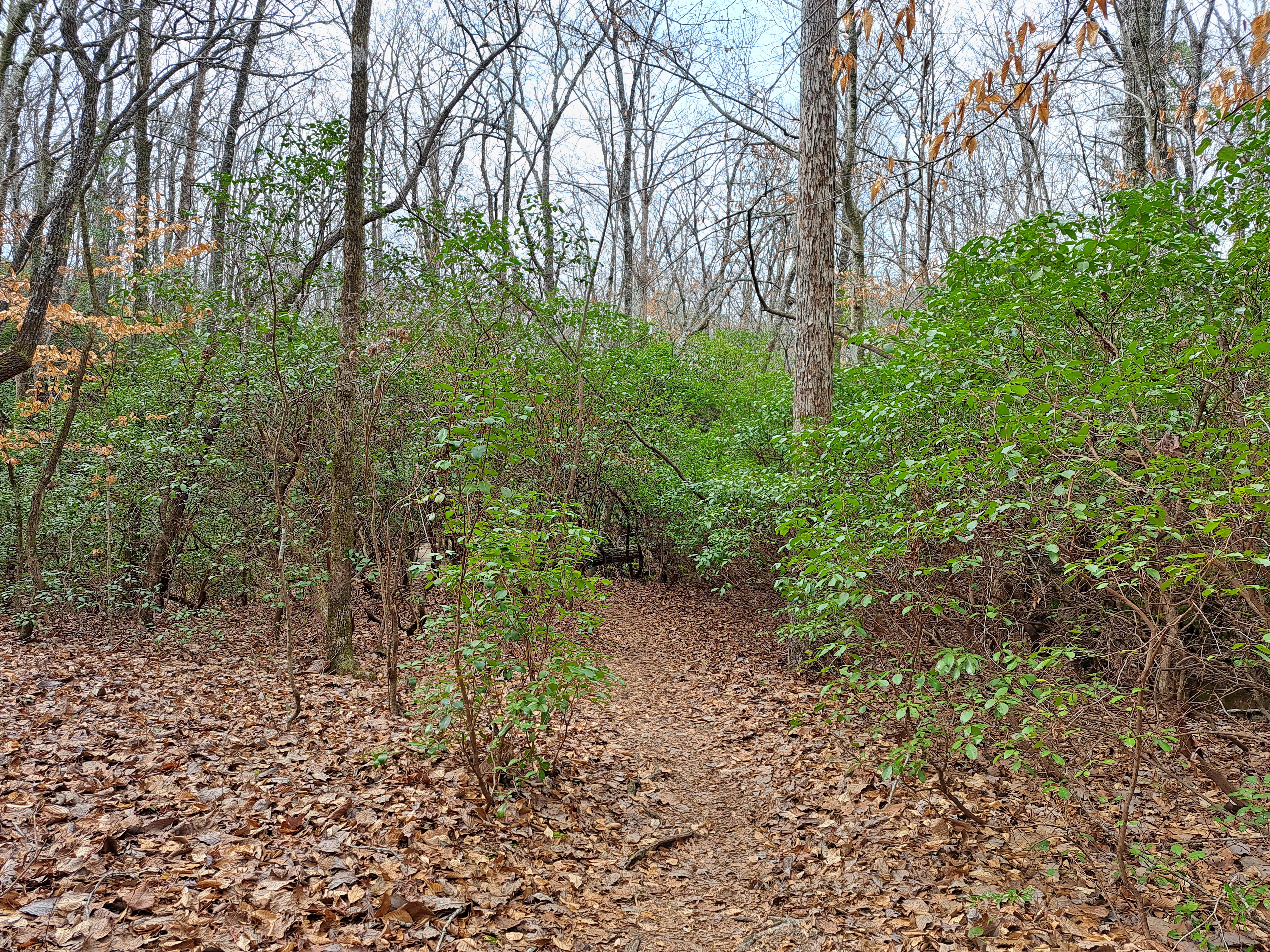
            Marked with red rectangular paint blazes, the Mountain Creek Trail descends to cross a tributary of Mountain Creek and reach a trail intersection.  The trail going right leads to a secondary campground, so you want to turn left to continue on the Mountain Creek Trail.  The forest is the usual Piedmont mix of pine and broadleaf trees as you go more down than up over gentle undulations.
Hiking through Piedmont forest
    
        The trail curves left to reach another trail intersection at 0.7 miles.  The trail continuing straight on the left (east) side of the creek leads to some picnic shelters and the dam of Delano Lake, so you want to turn right, cross the creek, and begin heading back downstream.  Watch for the plentiful red blazes at each of these intersections to stay on the right trail.
Hiking along Mountain Creek
    
        For the next 0.5 miles the trail stays close to Mountain Creek, which at times flows through a steep channel.  A light rain began falling as I hiked here, and I thought about how much I preferred hiking this trail in 60 degrees with a light rain versus 90 degrees with full sun.  At 1.2 miles, the trail curves left to begin a long and gradual climb away from Mountain Creek.  The difference between minimum and maximum elevations on this hike is less than 200 vertical feet, so all climbs are either very gradual or do not last long.
Hiking away from Mountain Creek
    
        1.9 miles into the hike, you reach a pair of abandoned fish hatcheries.  Constructed by the CCC, the excellent stonework at the fish hatchery dams looks out of place in the middle of the woods today.  A couple of benches invite you to sit, rest, and enjoy a trail snack near the midpoint of this hike.
Abandoned CCC Reservoir
    
        Just past the fish hatcheries, you reach a major trail intersection.  The option going right leads to the aforementioned Pine Mountain Trail, and the option going left leads to the park's cabin area.  Continue straight to remain on the Mountain Creek Trail.  Now the ravine narrows and the grade steepens as you begin the hardest climb of this hike.  Given the elevation information mentioned above, this climb barely works up a sweat.
Rocky area near ridgetop
    
        Near 2.4 miles, you cross first Lake Delanor Road, an extension of the road you drove in on, and then a power line corridor as you pass the highest elevation on this hike.  The rocky areas on top of this ridge contrast with the creekside areas you hiked through earlier.  Next comes the steepest descent as the trail plunges back into a creekside area.  This ravine is clogged with large amounts of mountain laurel.
Mountain laurel thicket
    
        Just shy of 2.9 miles, you cross the Cabin Trail and the Delano Trail as you enter the campground.  Avoid walking into occupied campsites, and soon the trail comes out at the campground road.  Walk along the campground road, cross the main park road, and reach your car in the parking lot in front of the campground's Trading Post to complete the hike.  While you are here, you can check out scenic Lake Delano or take a short drive to one of several scenic views from the Pine Mountain Range along nearby SR 190.