Showing posts with label Rhode Island Hikes. Show all posts

Monday, August 12, 2019

Beavertail State Park (Blog Hike #759)

Trails: (unnamed)
Hike Location: Beavertail State Park
Geographic Location: south of Jamestown, RI (41.45181, -71.39946)
Length: 2.3 miles
Difficulty: 2/10 (Easy)
Date Hiked: July 2019
Overview: A loop hike around Beavertail Point featuring Beavertail Lighthouse.
Photo Highlight:

Directions to the trailhead: Jamestown occupies an island in Narragansett Bay that is reached by taking SR 138 west out of Newport or east out of Kingstown.  After reaching the island, go south on North Road, which becomes Beavertail Road in the center of Jamestown the town.  Drive a total of 5.6 miles from SR 138 to reach Beavertail Rd.’s end at Beavertail State Park.  I started my hike at parking lot #2, although this hike passes through all 4 of the park’s parking lots.  On warm weather weekends, you will need to park wherever you can find a space.

The hike: Separating two of the main waterways from the Atlantic Ocean in to Narragansett Bay, Beavertail Point occupies a sentinel place in American maritime history.  The first Beavertail Light was built here in 1749, and it was only the third lighthouse erected on what would become the United States’ east coast.  The original wooden lighthouse burned down 4 years later, but the second structure lasted until the current granite lighthouse was built in 1856.
            Beavertail Point also became important during World War II.  Fort Burnside was constructed on this site as part of a picket line of coastal defenses.  The defenses protected New England’s wartime manufacturing plants, and remnants of Fort Burnside will be seen on this hike.
            Fort Burnside ceased operations in 1978, and in 1980 Beavertail State Park was created out of Federal Surplus Land to protect historic Beavertail Point.  In addition to preserving the lighthouse, the park offers some of Rhode Island’s best saltwater fishing.  While hiking is not this park’s main attraction, the park offers several miles of trails.  The hike described here forms a loop around Beavertail Point, and it features all of the park’s points of interest including the lighthouse, the World War II sites, and the park’s scenic coastline.
View south from parking lot #2
            From parking lot #2, Beavertail Light looms to the south, so you may as well start by heading to the lighthouse.  The rocky coast comes into view to the right as you walk toward the Light through a small mowed grass area.  Some wild roses in bloom aromatized my steps on the warm humid afternoon in late July that I came here.
            At 0.2 miles, you reach Beavertail Light.  The Light is surrounded by a number of auxiliary buildings, and a small gift shop and museum tells the story of the lighthouse’s history.  The lighthouse remains operational today.  There is a trail map on display in the museum, and I recommend taking a picture of it for use on your hike because the park’s trails are neither well-marked nor well-maintained.
Beavertail Light
            After touring the Light, continue a clockwise route around Beavertail Point by walking up the outbound park road or paralleling the road in the mowed grass area between the road and the coast.  Some round stone foundations in this area are the first remnants of Fort Burnside passed on this hike.  While I could not find any specific information about any of the old Fort Burnside structures, these stones look like foundations for a gun battery.  I had a reflective time thinking about what this area might have looked like during World War II.
Round stone foundation
Rocky coast at Beavertail Point
Upon reaching parking lot #4, look for a narrow dirt trail that leaves the mowed grass area and heads into the coastal scrub.  A sign with a QR code marks this point.  The narrow trail goes along the coast before curving inland at a grassy field.  Due to the grass and the narrowness of the trail, I recommend checking yourself for ticks after this hike.  My post-hike inspection yielded one such creepy crawly critter on my socks, and I managed to cast it back into the grass before it bit me.
Old Fort Burnside structure
At 0.8 miles, you reach a rusty metal structure, the most obvious remnant of Fort Burnside.  This structure looked like an old storage building to me, but again I could not find any sources to confirm my hunch.  Past this point, the trail widens to a two-track grassy road that leads out to the main park road.  To continue this hike, turn right on the park road and walk the park road to parking lot #1, the north end of which contains one of the park’s main trailheads.  Re-enter the woods at a sign that warns “no motor vehicles.”
            The main trail in this part of the park heads north with side trails branching off left and right.  The trails in this area form a real maze, and the lack of trail markings makes it very hard to stay on a chosen course.  My best advice is to keep heading in the general direction of north until, at 1.4 miles, you reach an old asphalt road that roughly marks the park’s north boundary.  Turn left on the old asphalt road to begin heading west.
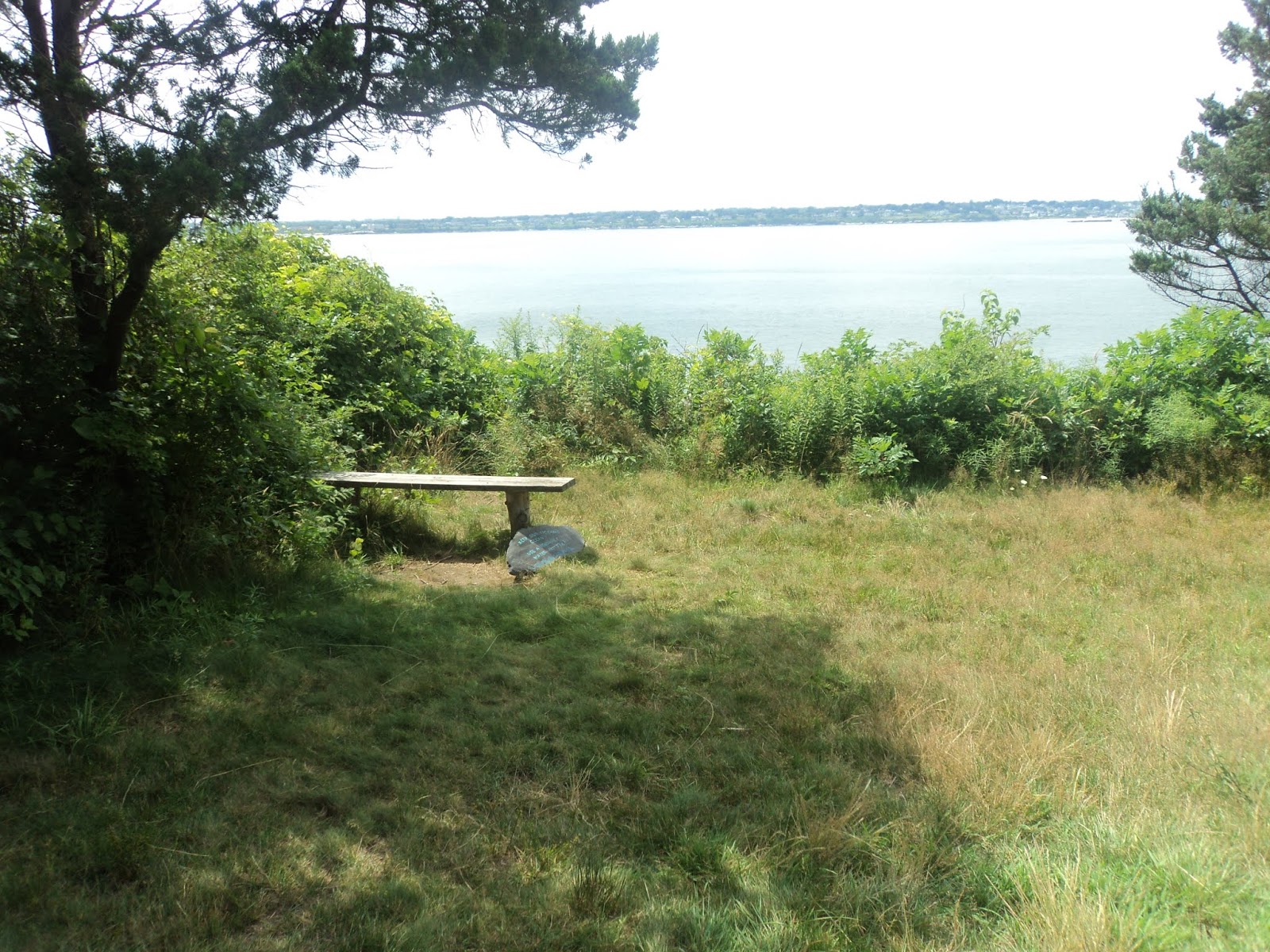
Bench at end of asphalt road
            Just after the asphalt ends, you reach a bench that provides a nice view off the west side of Beavertail Point.  The trail curves left here and begins heading south with the rocky coast to the right.  Ignore trails that exit left and head inland.  Parts of this trail are very narrow or muddy, making for unpleasant hiking conditions.  With the lighthouse and the area’s history, this hike could be a real winner with better trail markings and maintenance.  If things go according to plan, you will come out at the north side of parking lot #2 at 2.3 miles.  If you accidentally come out at the park road as I did, you can simply walk the park road back to parking lot #2 and complete your hike that way.

Tuesday, September 8, 2015

Powder Mill Ledges Wildlife Refuge (Blog Hike #545)

Trails: Orange, Blue, and Yellow Trails
Hike Location: Powder Mill Ledges Wildlife Refuge
Geographic Location: south side of Smithfield, RI (41.86837, -71.53041)
Length: 1.7 miles
Difficulty: 2/10 (Easy)
Date Hiked: August 2015
Overview: A gently undulating loop through a wide variety of habitats.
Hike Route Map: https://www.mappedometer.com/?maproute=943686
Photo Highlight:

Directions to the trailhead: On the west side of Providence, take I-295 to US 44 (exit 7).  Exit and go west on US 44.  Drive US 44 west 0.6 miles to SR 5 and turn left on SR 5.  Drive SR 5 south 0.2 miles to the refuge entrance on the left.  Turn left to enter the refuge, and park in the gravel parking lot beside the Audubon Society headquarters building.

The hike: Owned and operated by the Audubon Society of Rhode Island, Powder Mill Ledges Wildlife Refuge protects 120 acres in highly developed central Rhode Island.  The refuge’s name comes from a gunpowder factory/mill that operated in the area during our nation’s early days.  The exact location of the mill is uncertain, but the road we know today as US 44 was originally chartered as the Powder Mill Turnpike in 1810.  An inn for pioneer travelers operated on this site in the early 1800’s.
            Today the refuge serves as the headquarters for the Audubon Society of Rhode Island.  The headquarters building beside the parking lot contains a gift shop, a teacher’s resource center, and a bird feeding station, but it is only open Monday through Friday.  The refuge’s three trails, on the other hand, are open dawn to dusk seven days per week.  The three trails form successively longer loops, and hiking the longest loop forms the 1.7 mile hike described here.
Orange Trail trailhead
            From the side of the headquarters building, the Orange Trail, the first of the three successive loops, leaves in two directions: left and right.  This trail description uses the right option as the outbound route and the left option as the return route, thus hiking the loop counterclockwise.  The trail heads roughly south with a meadow through the trees first on the left and later on the right.  The meadows were full of colorful purple flowers when I hiked here in mid-August.
            Where the inner loop of the Orange Trail exits left, angle right to hike the full Orange Trail.  After passing some old stone walls that separated farm fields long ago, you reach a narrow wooden boardwalk.  This boardwalk crosses a small seasonally wet area that features some young pine trees.  Once across the boardwalk, the trail curves left to climb gradually to reach the top of a small hill.
Boardwalk on Orange Trail
            At 0.4 miles, you reach the intersection with the Blue Trail, which exits right.  If you wanted a short hike of only 0.8 miles, you could continue straight and hike only the Orange Trail.  For a longer tour, turn right to begin the Blue Trail.  The Blue Trail assumes a gently rolling course as it heads east through a pine planting.
            Just past 0.6 miles, you come out at a wide high voltage power line clearing and an intersection with the Yellow Trail.  Again you can choose to short circuit the hike if you wish, but this description turns right to begin the Yellow Trail.  After passing a bench, the Yellow Trail continues this hike’s eastward course as it heads under the power lines.  I counted no less than 17 power lines in this corridor, and the shrubby, slightly rocky terrain gives this area all the charm of an urban industrial park.
Power lines
            The trail enters the woods on the other side of the power lines and continues east to intersect another sign of suburbia: a gravel road used by utility crews to access a transformer.  Look for the yellow paint blazes to find where the trail reenters the forest on the other side of the road.  Nearing the refuge’s eastern boundary, the trail curves left to begin heading north through young broadleaf forest.  Honestly, the young forest, power lines, and gravel road ensure that the Yellow Trail does not make for the most scenic hiking.
Hiking the Yellow Trail
            More gradual left turning brings the trail back first to the gravel road and then to the power lines.  Upon reaching the power lines, the trail curves left and begins climbing gradually under the wires on a two-track gravel path.  This turn is not marked, but the thick undergrowth below the power lines makes it difficult to get off of the trail.  I also heard some ATV’s on this path, so keep an open ear and eye as you walk.
            1.2 miles into the hike, you close the loop of the Yellow Trail.  The gravel path continues south under the power lines here, so be on the lookout for this intersection.  Turn right to get back to the Blue Trail, then turn right again to continue the Blue Trail.  The Blue Trail stays on the edge of the power line clearing before curving left to leave the power lines for good (finally!) and reenter the more scenic pine forest.
Wolf tree
            Now heading slightly downhill, you pass some large trees with limbs very close to the ground.  These trees have lived here since the days when this land was cleared, and they are known as wolf trees.  At 1.5 miles, you reach the end of the Blue Trail at its intersection with the Orange Trail.  Turn right to continue the Orange Trail, then turn right again where the Orange Trail’s inner loop exits left.  After passing through another old stone wall, the Orange Trail curves left as it nears the refuge’s north boundary.  A brief walk through a meadow brings you back to the headquarters building to complete the hike.

Wednesday, August 19, 2015

Ninigret National Wildlife Refuge (Blog Hike #536)

Trails: Foster Cove, Cross Refuge, Grassy Point, and Charlietown Runway Trails
Hike Location: Ninigret National Wildlife Refuge
Geographic Location: southwest of Charlestown, RI (41.36814, -71.67210)
Length: 3.4 miles
Difficulty: 2/10 (Easy)
Date Hiked: August 2015
Overview: A flat, sunny loop hike through a World War II airbase turned wildlife refuge.
Hike Route Map: http://www.mappedometer.com/?maproute=453400
Photo Highlight:

Directions to the trailhead: From the intersection of US 1 and SR 112 in Charlestown, take US 1 south 2.3 miles to the refuge’s west entrance, which is on the left.  However, if you are traveling south on US 1, left turns are prohibited, so you must pass the entrance and do a U-turn at the next designated area to reach the entrance.  Park in the large blacktop parking lot.

The hike: Known as “Charlietown” to the young pilots who trained here during World War II, Ninigret National Wildlife Refuge partly occupies the former site of the Charlestown Naval Auxiliary Landing Fields.  The U.S. Navy purchased the former farmland in 1942 to build a training base for overseas night air operations during the war.  Pilots spent 4 months here training in hellcats before heading out for duty in the South Pacific.  Training exercises included tactics, gunnery, aircraft carrier landing, navigation, and instrument flying.
            The base’s most famous trainee was George H.W. Bush, the future 41st President of the United States, who trained here before being deployed to the USS San Jacinto in 1944.  The runways on which he would have landed hellcats can still be seen on this hike.  After the war, the base was used as a practice site for trainees at nearby Quonset Air Field.  In the early 1970’s, the base was closed, and the land was transferred to the National Fish and Wildlife Service for operation as the refuge you see today.  The refuge’s name comes from Ninigret Pond, a large saltwater body that forms the refuge’s southern boundary.
            The refuge is organized into two units: the Kettle Pond Unit located north of Charlestown and the Salt Pond Unit featured on this hike.  The Salt Pond Unit offers several short hiking trails.  Combining some of the short trails in a clever way forms the 3.4 mile refuge grand tour described here.
Start of Foster Cove Trail
            Three trails leave from the west entrance parking area.  This hike starts at the west entrance for the Foster Cove Loop Trail, which departs the west corner of the parking lot at an information board that contains a refuge trail map.  The dirt/gravel trail initially heads west, but it soon makes a near 180-degree sweeping left curve to begin heading southeast.  Just past 0.2 miles, you reach a small opening that gives a nice view of Foster Cove, an extension of Ninigret Pond that borders the refuge on the west.
Foster Cove
            The Foster Cove Loop Trail traces the boundary of its namesake cove as it passes through densely vegetated coastal shrubland.  Many different shrubs including honeysuckle and bittersweet live in this area.  Also, the large amount of water means that mosquitoes will appear in large numbers during the warmer months, so make sure you wear plenty of bug spray in season.
            At 0.5 miles, the Foster Cove Loop Trail intersects the Cross Refuge Trail.  If you wanted a short 0.9 mile hike, you could turn left here and complete the Foster Cove Loop Trail.  To get to the east side of the refuge and the best Ninigret Pond views, this hike continues straight on the Cross Refuge Trail.  True to its name, the Cross Refuge Trail connects the western and eastern sections of the refuge’s Salt Pond Unit.
            The trail soon crosses one of the airbase’s old runways, which is now a mixture of asphalt and gravel.  If you wanted to extend this hike, you could turn right on the asphalt and walk down the runway 0.4 miles to a Ninigret Pond fishing access, but we will get better views of the pond later in the hike.  The trail leaves the runway before curving left and then right to continue its general southeast course.  More shrubs and more ponds mean more bugs, so come prepared.
Crossing an old runway
            At 1.3 miles, the trail curves left where a gated road goes right.  Soon you cross another old runway as the trail heads northeast on what appears to be an old road.  Up to this point the trail has alternated between sun and shade, but full sun now prevails, a condition that will continue for most of the rest of the hike.
Hiking a hot, sunny trail
            1.6 miles into the hike, you reach the connector trail that connects the Cross Refuge Trail and the Grassy Point Trail.  Turn right to head for the Grassy Point Trail.  A small stand of coastal oak trees provides some welcome shade on a hot sunny day.  When you reach the wide gravel Grassy Point Trail at a T-intersection, turn right to head for Grassy Point.
            The trail curves left as it heads out Grassy Point, a peninsula that sticks well out into Ninigret Pond.  Interpretive signs tell of this land’s agricultural history before it became a naval base.  When this area was first settled in the 1600’s, the flat, fertile, rock-free glacial outwash that now surrounds you was some of the best farmland in the area.  Large plantations grew everything from corn to vegetables to potatoes, and profitable grazing and fishing industries also thrived here.
            2 miles into the hike, you reach Grassy Point.  Views into Ninigret Pond extend in three directions, and a provided pair of binoculars allows you to identify wildlife at a distance.  A bench provides a nice spot to rest and enjoy the scenery just past the midpoint of the hike.
View from Grassy Point
The trail ends at Grassy Point, so your next move is to turn around and retrace your steps back up the peninsula.  Where the connector trail exits left, continue straight to stay on the Grassy Point Trail.  At 2.4 miles, you need to angle left to begin heading back toward the trailhead.  If you wanted to extend your hike, the trail going right leads a short distance to another view of Ninigret Pond that is similar to the one you obtained earlier.
Very quickly you step onto asphalt that is the end of old airbase runway 30, the longest runway at the airbase.  Large white painted numbers “30” designed to be seen from the air can still be made out on the ground.  2.5 miles into the hike, you reach the paved east parking lot.  To begin the final segment back to our (west) parking lot, walk directly across this parking lot and pick up the paved Charlietown Runway Trail.  A sign warns of ticks, but they should not pose a problem if you stay on the trail.
Runway 30
As its name suggests, the Charlietown Runway Trail traces the entire 0.8 mile length of old runway 30.  As such, the paved trail is completely flat and almost dead straight.  The facilities of adjacent Ninigret Park can be seen to the right as you hike along the refuge boundary.  Reaching the west parking lot located at the other end of the Charlietown Runway Trail signals the end of the hike.