Showing posts with label Kentucky Hikes. Show all posts

Monday, December 29, 2025

Greenbo Lake State Resort Park: Michael Tygart Trail to Pruitt Fork (Blog Hike #1098)

Trail: Michael Tygart Trail
Hike Location: Greenbo Lake State Resort Park
Geographic Location: southwest of Greenup, KY (38.48497, -82.88413)
Length: 3 miles
Difficulty: 5/10 (Moderate)
Date Hiked: October 2025
Overview: A lakeside out-and-back to an old primitive campsite along Pruitt Fork.
Park Information: https://parks.ky.gov/explore/greenbo-lake-state-resort-park-7790
Hike Route Map:
On The Go Map
Photo Highlight:
Hike Video: (coming May 14, 2027)

Directions to the trailhead: From the intersection of US 23 and SR 1 in Greenup, take SR 1 south 7.6 miles to SR 1711 and turn right on SR 1711.  SR 1711 dead-ends at the park entrance.  Drive SR 1711 a total of 3 miles to reach the park's marina, then angle left on a one-lane road to reach the small trailhead parking area in another 0.1 miles.

The hike: Tucked in the hills and hollows of northeast Kentucky just a few miles from the Ohio River, Greenbo Lake State Resort Park owes its existence to a series of locally-organized meetings at the nearby Greenup Fish and Game Club in 1948.  The meetings built local support for the development of a recreational lake in the area, and the Greenbo Recreation Association was formed to handle the project in conjunction with the Kentucky Department of Fish and Wildlife Resources.  The name Greenbo comes from combining the names of Greenup and Boyd Counties, where the majority of the meeting attenders lived.  Land purchase was completed in 1954, and the park became a Kentucky state park in 1955.
            Today 300-acre Greenbo Lake remains the center of the park, but the park also features a full-service lodge, a 63-site developed campground, and a scuba area.  Greenbo Lake State Resort Park offers over 25 miles of trails for hikers, mountain bikers, and horseback riding, but most of the trails do not form manageable loops for dayhiking.  The hike described here is an out-and-back on the northern part of the 8.5 mile Michael Tygart Trail; it offers manageable terrain with nice lake views and a couple of other points of interest.
Marina trailhead
    
        From the rear of the parking area, pick up the Michael Tygart Trail as it crosses a small wooden footbridge and enters the woods.  A white mailbox at the trailhead contained trail maps when I came here.  The Michael Tygart Trail is marked with yellow paint blazes, and the large number of blazes make the map kind of unnecessary for this hike.  I always feel better carrying an ink-and-paper map, so I took one anyway.
Best Greenbo Lake view
    
        On the initial segment of trail the main channel of Greenbo Lake stays through the trees to the right, and just shy of 0.2 miles you reach a small open area that gives this hike's best lake view.  Leaves were just starting to change color when I came here in mid-October, but this park's mixture of oak and pine forest does not make for the best leaf-peeping at any time.  Past the lake view, the trail undulates with a large number of short and occasionally steep ups and downs.  These undulations combined with the large number of roots in the trail surface make the going slower than you might expect.
Hiking on rooty trail
    
        At 0.4 miles, the trail curves left to head around a lake inlet.  The steepest climb of this hike comes as you are exiting the inlet.  0.6 miles into the hike, a wooden sign marks a connector trail that heads uphill to the left.  This connector trail is also on the trail map, but it was sufficiently overgrown to make it unfindable on my visit.  Thus, I followed the yellow blazes to stay on the clear Michael Tygart Trail.
Hiking around a lake inlet
    
        At 0.75 miles, the trail curves left again to head up the Pruitt Fork inlet.  This inlet is a much larger inlet than the first one you circled, and it is shaped like a crooked finger with the crook going to the left/west.  More undulations bring you past the yellow carsonite post 1 mile marker to the head of the inlet at 1.35 miles.  A large slump block sits beside the trail here; it is the only significant rock feature on this hike.
Large slump block
    
        1.4 miles into the hike, you reach some old benches and a fire ring that might be an old primitive campsite.  The surroundings are very shrubby and unattractive, but the benches make nice places to sit and rest.  In another 0.1 miles, you pass the other end of the unfindable connector trail; this end is also signed but otherwise unfindable.
Old campsite
    
        Immediately after passing the connector trail, you reach an unbridged crossing of Pruitt Fork.  I did not bring my water shoes to wade the creek, so I turned around here and retraced my steps to the trailhead to complete the hike.  Within the next mile of the Michael Tygart Trail sits a boy scout camp and an old homestead if you feel like wading the creek and extending your hike.


Monday, December 2, 2024

General Burnside Island State Park: Point Isabel Trail (Blog Hike #1030)

Trail: Point Isabel Trail
Hike Location: General Burnside Island State Park
Geographic Location: south of Somerset, KY (36.97541, -84.59766)
Length: 2 miles
Difficulty: 4/10 (Moderate)
Date Hiked: September 2024
Overview: An out-and-back to a fantastic overlook of the Cumberland River.
Park Information: https://parks.ky.gov/explore/general-burnside-island-state-park-7812
Hike Route Map: https://www.mappedometer.com/?maproute=972909
Photo Highlight:
Hike Video:

Directions to the trailhead: From downtown Somerset, take US 27 south 9.5 miles to the signed park entrance on the right.  Turn right to enter the park, and park on the right side of the large blacktop parking lot for boat trailers.  This parking lot is located just before reaching the ranger station and old swimming pool.

The hike: Located deep in the hills of south-central Kentucky, cozy General Burnside Island State Park protects 430 acres on an island where the Cumberland River receives its Big South Fork.  The island was created with the construction of Wolf Creek Dam and Lake Cumberland in 1939, and the park was formed in 1958.  The park is named for General Ambrose E. Burnside, a Union Civil War general.  Although Burnside is most famously connected with the Burnside Bridge at Antietam, he later commanded Union troops in the Civil War's western theater including here and in eastern Tennessee.
            Today the park is best known for its golf course, which consistently ranks as one of the best public courses in Kentucky.  The park also features a 94-site developed campground, a marina on Lake Cumberland, and several picnic areas.  For hikers, General Burnside Island State Park offers only 1 trail, but it is a good out-and-back trail that leads along a hillside past Burnside's historic defenses to a fantastic river overlook.  Such is the hike described here.
Picnic area trailhead
    
        From the parking lot, your first task is to find the trailhead.  Walk inbound (south) 
on the main park road out of the parking lot, then turn right on a gated paved picnic area road.  The trailhead is on the right in a couple hundred feet; a brown carsonite post and a sign stating trail regulations mark this trailhead.
Hiking the Point Isabel Trail
    
        The single-track dirt trail climbs steeply but only for a short distance.  The mixed pine and broadleaf forest features a dense understory of honeysuckle.  The trail stays in a fairly narrow swath of forest with the developed area of the park uphill to the left and a cliff through the trees to the right.  After passing through a power line corridor, ignore a signed spur trail that exits left.
Old stone wall
    
        At 0.6 miles, the trail starts paralleling a stone wall on the right.  Interpretive signs tell you that General Burnside stationed his troops in this area, probably using the steep hill that falls to the right as a natural defense.  After a short climb and shorter rocky area, you come out at the campground road.  As directed by a sign, angle right to begin walking along the road and continue heading for Point Isabel.
Entering the campground
    
        When you get to campsite #27, the trail exits the road to the right.  Again, a nice wooden sign marks this turn.  Turn right and top a final rocky section to reach the Point Isabel overlook.  Legend says that this overlook is named for a girl named Isabel who did a "lover's leap" to her death here, but details of her or her circumstances are sketchy.
Point Isabel overlook
    
        Point Isabel offers a fantastic northward view from more than 100 feet above the Cumberland River, which looks more like a lake than a river at this point.  You can also see the SR 90 river bridge in the distance.  The trail ends here, so the only option is to retrace your steps to the trailhead and parking lot to complete the hike.


Sunday, November 26, 2023

Big Bone Lick State Historic Site: Cedar Run/Big Bone Creek Double Loop (Blog Hike #969)

Trails: Gobbler's Trace, Cedar Run, Bison Trace, and Big Bone Creek Trails
Hike Location: Big Bone Lick State Historic Site
Geographic Location: southwest of Union, KY (38.88424, -84.75212)
Length: 2.7 miles
Difficulty: 5/10 (Moderate)
Date Hiked: October 2023
Overview: A double loop passing the park's bison pen and fossilized bone dig site.
Park Information: https://parks.ky.gov/union/parks/historic/big-bone-lick-state-historic-site
Hike Route Map: https://www.mappedometer.com/?maproute=948925
Photo Highlight:
Hike Video:

Directions to the trailhead: In northern Kentucky, take I-75 to SR 338 (exit 175).  Exit and go west on SR 338.  Drive SR 338 west 7 miles to the park entrance on the left.  Turn left to enter the park, then turn right at the first intersection.  Park in the blacktop lot in front of the park's Museum/Visitor Center.

The hike: I first drove into Big Bone Lick State Historic Site in August 2000 when I worked in Fort Mitchell, KY a few miles to the north.  I came here after work one humid summer evening, and I only hiked the Coralberry Trail around this park's lake, never bothering to visit this park's famous mammoth and mastodon fossil dig site.  Likewise when I returned here to take some photos on a 100+ degree day in 2012, I confined myself to the trail I had hiked several years earlier.  Finally, as the first stop on my October 2023 hiking trip to Michigan and Ohio, I did a hike through the main part of the park on my third visit to Big Bone Lick.
            The fossil dig site that eluded my presence for so long has been an important site for centuries.  Before European settlers arrived, the Shawnee lived here, and Mary Draper Ingles was held hostage here before her daring escape back to Virginia.  Daniel Boone came here in 1770, and future President William Henry Harrison came here to collect fossils in 1795.  Meriwether Lewis of Lewis and Clark fame dug for fossils here in 1803, and the park today is a stop on the Lewis and Clark Heritage Trail.
            Despite the site's impressive history, Big Bone Lick State Historic Site dates only to 1960.  The park offers a fantastic Visitor Center, which features fossil and art exhibits, a 62-site developed campground, and several hiking trails.  My earlier hike on the park's Coralberry Trail is described elsewhere in this Trail Journal, and this hike focuses on the trails that start at the Visitor Center, including the trails through the famous dig site and around the almost as famous bison pen.
Trailhead across from Visitor Center
    
        To take the long route to the bison pen and save the dig site for last, start across the parking lot from the Visitor Center and pick up the Gobbler's Trace as it heads southeast, going steeply uphill.  The Gobbler's Trace is the main trail connecting the park's Visitor Center and campground; it is well-trodden and marked with blue rectangular paint blazes.  Some wooden steps make the climb easier, but this is a steep ridge.  Oak and black walnut trees dominate the forest on the lower parts of the ridge.
Climbing the ridge
    
        After gaining almost 150 feet of elevation, you reach the ridgetop, and the trail flattens out.  Ignore (for now) the red-blazed Cedar Run Trail, which descends to the right, and stay on the blue-blazed Gobbler's Trace as it stays near the top of the narrow finger ridge.  Large numbers of red cedar trees and honeysuckle bushes grow up here, and the young forest allows a lot of light to reach the forest floor.
Trail intersection near park boundary
    
        At 0.55 miles, you reach a trail intersection with the park's east boundary straight ahead.  The Gobbler's Trace turns left here to continue its journey toward the campground, but you want to turn right to continue our first loop on the red-blazed Cedar Run Trail.  The Cedar Run Trail heads south with the park boundary on your left.  Some sections of this trail have been rerouted due to erosion problems, but the reroutes are well-signed and well-blazed.
Hiking the Cedar Run Trail
    
        The Cedar Run Trail uses a winding course that goes more downhill than uphill.  You may wonder whether this trail is taking you any direction in particular, but have some faith and keep following the red blazes.  At 1.4 miles, you reach another trail intersection.  The Cedar Run Trail continues straight to close its loop with the Gobbler's Trace, but you want to turn left on an unblazed spur trail marked "bison."
Spur trail to bison pen
    
        As the sign foretold, a moderate descent brings you to the bison pen at 1.5 miles.  Turn right to walk with the wire-fence pen to your left, and keep an eye out for the park's bison herd.  When I came here on a seasonally warm day in mid-October, most of the herd was laying in the shade, but I did see several bison here.  Take some time to admire these large scruffy animals.
Bison in bison pen
Bison pen
    
        After viewing the bison, walk the asphalt trail back to the parking lot to complete the first loop.  Next walk behind the Visitor Center to reach the viewing platform for the fossil dig site.  Statues of  mammoths, mastodons, and bones have been constructed to mark the area, and many interpretive signs describe the animals, fossils, and people who dug here.  Take some time to read the signs to appreciate the history of this site.
Fossil dig site
    
        Past the dig site, continue downhill and angle right to begin heading counterclockwise around the Big Bone Creek Trail's loop.  Soon you pass a couple of salt springs.  These springs are one reason so many large fossils were found in this area, and they still draw wildlife looking to replenish their body's salt today.  More interpretive signs describe the animals that frequent these springs.
Salt spring
    
        The rest of the Big Bone Creek Trail follows a nearly flat loop on mostly asphalt trail.  At 2.6 miles, you close the loop.  Turn right to walk back uphill past the Visitor Center to the parking lot to complete the hike.

Friday, November 4, 2022

Green River Lake State Park: Marina/Main and Scenic Overlook Trails (Blog Hike #902)

Trails: Marina/Main and Scenic Overlook Trails
Hike Location: Green River Lake State Park
Geographic Location: south of Campbellsville, KY (37.27162, -85.31492)
Length: 3 miles
Difficulty: 5/10 (Moderate)
Date Hiked: October 2022
Overview: A lollipop loop with many options featuring Green River Lake views.
Park Information: https://parks.ky.gov/campbellsville/parks/recreation/green-river-lake-state-park
Hike Route Map: https://www.mappedometer.com/?maproute=923236
Photo Highlight:
Hike Video: 

Directions to the trailhead: From Campbellsville, take SR 55 south 4.5 miles to SR 1061 and turn left on SR 1061.  Drive SR 1061 south 1.5 miles to the signed state park entrance on the left.  Turn left to enter the park, and drive the main park road to the park's boat ramp, which is located just before you reach the campground.  Park in the parking lot between the picnic shelter/playground and boat ramp.

The hike: Flowing down a meandering 384-mile east to west course, the Green River drains most of the large swath of Kentucky that lies between the Cumberland River watershed to the south and the Kentucky River watershed to the north.  The river is most famous for being the water outlet of Mammoth Cave, and my hike at Mammoth Cave National Park features good views of the Green River.  Historically the river's greatest influence has been economic.  By the 1840's the Green River was canalized as far upstream as Bowling Green, allowing barge traffic to navigate the river year-round.
            In 1969, the Army Corps of Engineers built the Green River Lake Dam, which has become the main impoundment along the river's main course.  Located well upstream from Mammoth Cave, the dam's main purpose is flood control.  Nevertheless, the Corps maintains a system of hiking trails near the dam, and the lake's north shore is home to Kentucky's Green River Lake State Park.  The park weighs in at 1331 acres, and its amenities include a 167-site developed campground, fishing, boating, and swimming in Green River Lake, and numerous picnic areas.  In fact, some of Kentucky's largest fish have been caught in the Green River.
            For trail users, the park offers 28 miles of trails, most of which are open to hikers, mountain bikers, and horseback riders.  The park's trail system is well-maintained but poorly marked, and the large number of interconnecting trails can make choosing a route to hike and/or following that route challenging.  The route described here gives good Green River Lake views and a taste of the park's hilly topography without pegging the difficulty meter, and thus it provides a good introduction to the park's trail system.
Trailhead at boat ramp
    
        From the picnic shelter and playground, walk southwest across the boat ramp and then look toward the lake to your left.  A sign that reads "Marina Main Trail 4.5 Miles" marks the trailhead.  As its name indicates, this trail connects the park's main area where you are now with the park's marina, which is located a few miles downstream.  Unfortunately, the trail is unmarked except for an occasional sign, so staying on this trail for the entire 4.5 miles can be a challenge, as I would learn.
Climbing beside the lake
    
        The narrow trail clings to the hillside as it climbs gradually.  After only a few hundred feet, you reach a rocky ledge that provides broad lake views.  This viewpoint is unprotected, so mind your footing: a slip would likely send you plunging into the lake.
Green River Lake view
    
        The trail switches back at the ledge and continues climbing through young forest dominated by red cedar trees.  After tracing around a roadside picnic area, the trail passes through a roadside mowed-grass area before reentering the woods.  A few wet areas need to be negotiated, but overall the gradual climb makes the going fairly easy.
Hiking around the picnic area
    
        At 0.7 miles, you dip slightly to reach a trail intersection.  A trail signed as the Scenic Overlook Trail goes left here, while the unsigned Marina/Main Trail goes right.  Drawn in by the name and a desire for more lake views, I turned left to begin the Scenic Overlook Trail.
Start of Scenic Overlook Trail
    
        Designed more for mountain bikers than hikers, the Scenic Overlook Trail embarks on a rolling winding course along a wide finger ridge.  While parts of the trail pass atop a bluff that overlooks the lake, I never came to anything I would call an overlook.  Some large beech trees live on this finger ridge, and the leaves were just starting to change color when I came here in early October.  Also, I did some nice wildlife viewing on this ridge that included several blue jays and multiple deer.
Hiking atop a lakeside bluff
    
        At 1.7 miles, you reach the unsigned other end of the Scenic Overlook Trail where it rejoins the Marina/Main Trail.  At the next intersection, the Fox Hollow Trail exits left.  Both options here lead out to the main park road, so you could go either way.  The Fox Hollow Trail dips into its namesake hollow, while the Marina/Main Trail stays close to the ridgetop.  I stayed with the Marina/Main Trail and came out at the park road 1.9 miles into the hike.
Hiking the Marina/Main Trail
    
        Several options present themselves here.  The Marina/Main Trail continues west and leads to more side trails that explore more ridges and hollows before ending at the park's marina.  Alternatively, you could retrace your steps along the Marina/Main Trail or the Scenic Overlook Trail.  Not liking either of those options, I chose to form a loop by walking the main park road back to the boat ramp.  Although the road receives moderate vehicle traffic, the wide shoulder allowed me to dodge the cars, and the road gave me a quick and easy route back to the trailhead.

Friday, July 30, 2021

Lake Cumberland State Resort Park: Lake Bluff Nature Trail (Blog Hike #856)

Trail: Lake Bluff Nature Trail
Hike Location: Lake Cumberland State Resort Park
Geographic Location: south of Jamestown, KY (36.92760, -85.04344)
Length: 4 miles
Difficulty: 8/10 (Moderate/Difficult)
Date Hiked: June 2021
Overview: A loop hike with some steep areas offering good blufftop Lake Cumberland views.
Park Information: https://parks.ky.gov/jamestown/parks/resort/lake-cumberland-state-resort-park
Hike Route Map: https://www.mappedometer.com/?maproute=876645
Photo Highlight:
Hike Video:

Directions to the trailhead: From Jamestown, take US 127 south 7 miles to the signed entrance road for Lake Cumberland State Resort Park on the left.  Turn left on the park road and drive the main park road 5.2 miles to its end at Lure Lodge.  Park in the large parking lot in front of Lure Lodge and the park's Activity Center; the trailhead is to the right (south) of the Activity Center's lower level.

The hike: Constructed in 1952 for power generation and flood control, the Wolf Creek Dam on the Cumberland River forms 65,530-acre Lake Cumberland, the 9th largest man-made lake by water volume in the United States.  The lake is 101 miles long and over 1 mile wide at its widest point.  Over 1500 houseboats float on the lake, and the area has become a popular summertime weekend getaway for people in the Midwest and the southeast.
            Perched on the lake's north shore is 3117-acre Lake Cumberland State Resort Park, a major recreation destination in the heart of southern Kentucky.  In addition to lake access, the park features 2 lodges, 20 cottages, a 129-site developed campground, a disc golf course that I reviewed in the Parking Full Time Disc Golf Reviews, a playground, some picnic areas, and 2 main hiking trails.  The Lake Bluff Nature Trail described here forms a loop around the developed part of the park.  While this hike is not the hardest in the region, some steep areas combined with some primitive trails meant I took nearly 3 hours to complete this hike.  With that warning, note that there are several bailout options you can use to short-cut the loop in case the difficulty becomes overwhelming.
Trailhead beside Activity Center
    
        From the information board beside the Activity Center's lower level, the trail descends some wooden steps and crosses the first of several small streams on short wooden footbridges.  Metal interpretive plaques embedded in low concrete bases describe common plants in this forest, which include some large beech trees, some oaks, and some paw paw bushes.  The hillsides in this area are very steep, and after the initial descent the narrow trail assumes a sidehill course with a small inlet of Lake Cumberland downhill and to the left.
Hiking sidehill trail
    
        Soon the lake inlet turns into a creek, and at 0.5 miles the signed spur trail to the campground store exits right.  Angle left to descend and cross the creek on a longer wooden footbridge.  Next the trail curves left to head back out toward the lake as it climbs the opposing ridge.  This climb is gradual at first, but it gets quite steep just before reaching the crest of the ridge.
Reaching the ridge crest
    
        Just shy of 1 mile, you reach a T-intersection at the crest of the ridge.  We will eventually turn right to continue the main loop, but first turn left to hike a short spur trail to a rocky overlook that gives your first good Lake Cumberland view.  Although some trees partially obstruct the view, this east-facing overlook allows you to peer out over the lake's main channel, and it gives you some idea of just how large this lake is.  Boats will likely be zooming around in the water, so take a few minutes to see what you can see.
Lake Cumberland's main channel
    
        Back on the main loop, the next 0.7 miles is my favorite section of the loop: it assumes a rolling course 
through mature forest atop the bluff with the lake 150 feet below you to the left.  I did some nice wildlife viewing here that included a deer with her fawns and a raccoon.  After dropping and rising steeply to pass through a ravine, the trail curves right to head away from the lake.
Hiking atop the bluff
    
        2 miles into the hike, you reach the first of three park road crossings that occur within the next half mile.  At
 all three crossings, wooden signs that say "Nature Trail" and yellow aluminum rectangles mark where the trail crosses the road and re-enters the woods.  Overall, although occasionally the path on the ground is faint, this trail is well-marked.
Re-entering the woods after road crossing
    
        After crossing the park's campground road, the third of the three aforementioned road crossings, you begin a long descent in and around another heavily wooded ravine.  At 2.8 miles, the trail curves left to begin following an old road and head for the park's Pumpkin Creek Lodge.  The park's cottages can be seen uphill to the right.  The hillside is very steep here, but the old road makes for a wide sidehill trail and relatively easy going.
Narrow trail behind lodge
    
        Just past 3 miles, you reach a trail intersection.  The trail going right climbs directly to the parking area in front of Pumpkin Creek Lodge while the official Lake Bluff Nature Trail goes left to circle around the back of the lodge and reach the same parking area.  This section of official trail is steep, narrow, eroded, and borderline dangerous: a slip would send you tumbling down the steep hillside toward Lake Cumberland.  While I managed to navigate the official trail without serious incident, I think it would be best to close that section of trail and reroute the official trail to the front of the lodge.
View over park's boat dock
    
        Regardless of how you make it to the parking lot in front of Pumpkin Creek Lodge, the trail heads up the north side of the lot before crossing the boat dock access road.  A final brief stint in the woods brings you to the park's disc golf course in a thinly forested area along the Lure Lodge access road.  The sight of your car in the parking lot downhill to the right tempts you to skip the final section of the Lake Bluff Nature Trail, but hikers who keep following the aluminum trail markers will be rewarded with an outstanding view over the park's huge boat dock from a rocky bluff some 150 feet above the water.  After taking in this view, head down to the parking lot that contains your car to complete the hike.  While you are here, the park's disc golf course also starts near this trailhead, and I had a nice time walking around the sunny and hilly disc golf course after I finished my hike on the Lake Bluff Nature Trail.

Sunday, July 4, 2021

Daniel Boone National Forest, Bald Rock Picnic Area: Sugar Tree Hollow Trail (Blog Hike #853)

Trail: Sugar Tree Hollow Trail (Daniel Boone National Forest Trail #407)
Hike Location: Daniel Boone National Forest, Bald Rock Picnic Area
Geographic Location: west of London, KY (37.03296, -84.22387)
Length: 1.5 miles
Difficulty: 4/10 (Moderate)
Date Hiked: June 2021
Overview: A short loop through steep ravines passing several small cascades and sandstone cliffs.
Trail Information: https://www.fs.usda.gov/recarea/dbnf/recreation/recarea/?recid=39640
Hike Route Map: https://www.mappedometer.com/?maproute=876079
Photo Highlight:
Hike Video: 

Directions to the trailhead: In southern Kentucky, take I-75 to SR 192 (exit 38).  Exit and go west on SR 192.  Drive SR 192 west 9.6 miles to the signed Bald Rock Picnic Area on your right.  Turn right to enter the picnic area, and park in the small gravel lot near the restrooms.

The hike: Often overlooked in favor of Daniel Boone National Forest's more famous nearby hiking destinations such as Natural Arch and Bee Rock, Bald Rock Picnic Area occupies the ridgetop site of the former Bald Rock Fire Tower.  The tower was staffed by trained fire watchers until the 1970's, at which time fire watching from aircraft began.  Today only some small pegs from the tower's foundation remain, and they are visible beside an interpretive sign in the middle of the picnic area road's small loop.
            For hikers, Bald Rock Picnic Area is the jumping off point for two trails.  The Cane Creek Trail leads several miles along its nearby namesake creek, and it offers both hiking and backpacking opportunities as well as backcountry fishing in Cane Creek.  The only route from the picnic area to the Cane Creek Trail is the Sugar Tree Hollow Trail, the short 1.5 mile loop described here.  The Sugar Tree Hollow Trail offers a sample of hiking through the rugged hollows of southern Kentucky without pegging the length or difficulty meters, and it makes a scenic but primitive after-picnic hike.
Picnic area trailhead
    
        From the gravel parking lot, walk downhill behind the restroom building and look for the signed start of the trail at the edge of the woods to your left.  Marked with white plastic diamonds, the narrow primitive trail heads steeply downhill over a rooty and eroded course.  At one point the small stream and trail seem to converge, and the footing is very tricky on this initial segment of trail.
Descending on eroded trail
    
        As you approach the bottom of the ravine, the footing improves as the trail assumes a hillside course a few vertical feet above the stream.  The forest in this ravine features some 
large tulip poplar and beech trees with some small hemlocks and many paw paw bushes.  A couple of small side streams need to be stepped across, and these small streams contain some equally small waterfalls.
Stepping across a creek

2 talus boulders
    
        The trail weaves around some large and interesting talus boulders before the connector trail that leads to the Cane Creek Trail exits right at 0.7 miles.  Angle left to continue the Sugar Tree Hollow Trail.  The climb back to the picnic area now begins as the trail heads up another tight side ravine.  The difference in elevation between the picnic area and the bottom of the ravine is only about 230 vertical feet, but the damp hollow and primitive trail make the going more challenging than you might expect.
Sandstone cliffs
    
        This ravine features some nice exposed sandstone cliffs above you and to the left, and decent numbers of ferns carpet the forest floor.  After exiting the top of the ravine, the trail curves left to exit the woods near Bald Rock Picnic Area's entrance.  Turn left and walk past some picnic tables to return to the parking area and complete the hike.


Saturday, August 1, 2020

Camp Catalpa Park in Richmond, KY (Blog Hike #806)

Trail: Yellow Trail
Hike Location: Camp Catalpa Park
Geographic Location: east side of Richmond, KY (37.74069, -84.24936)
Length: 0.8 miles
Difficulty: 1/10 (Easy)
Date Hiked: June 2020
Overview: A short loop partly along Reba Lake.
Park Information: https://www.richmond.ky.us/Facilities/Facility/Details/Camp-Catalpa-Park-5
Hike Route Map: https://www.mappedometer.com/?maproute=940312
Photo Highlight:
Hike Video: 

Directions to the trailhead: From the intersection of US 25/421 and SR 52 on the east side of Richmond, take SR 52 east 0.5 miles to Catalpa Loop Road.  Take a soft right on Catalpa Loop Rd.  The signed entrance to Camp Catalpa Park is another 0.4 miles ahead on the right.  Turn right to enter the park, and park in the only paved parking lot.

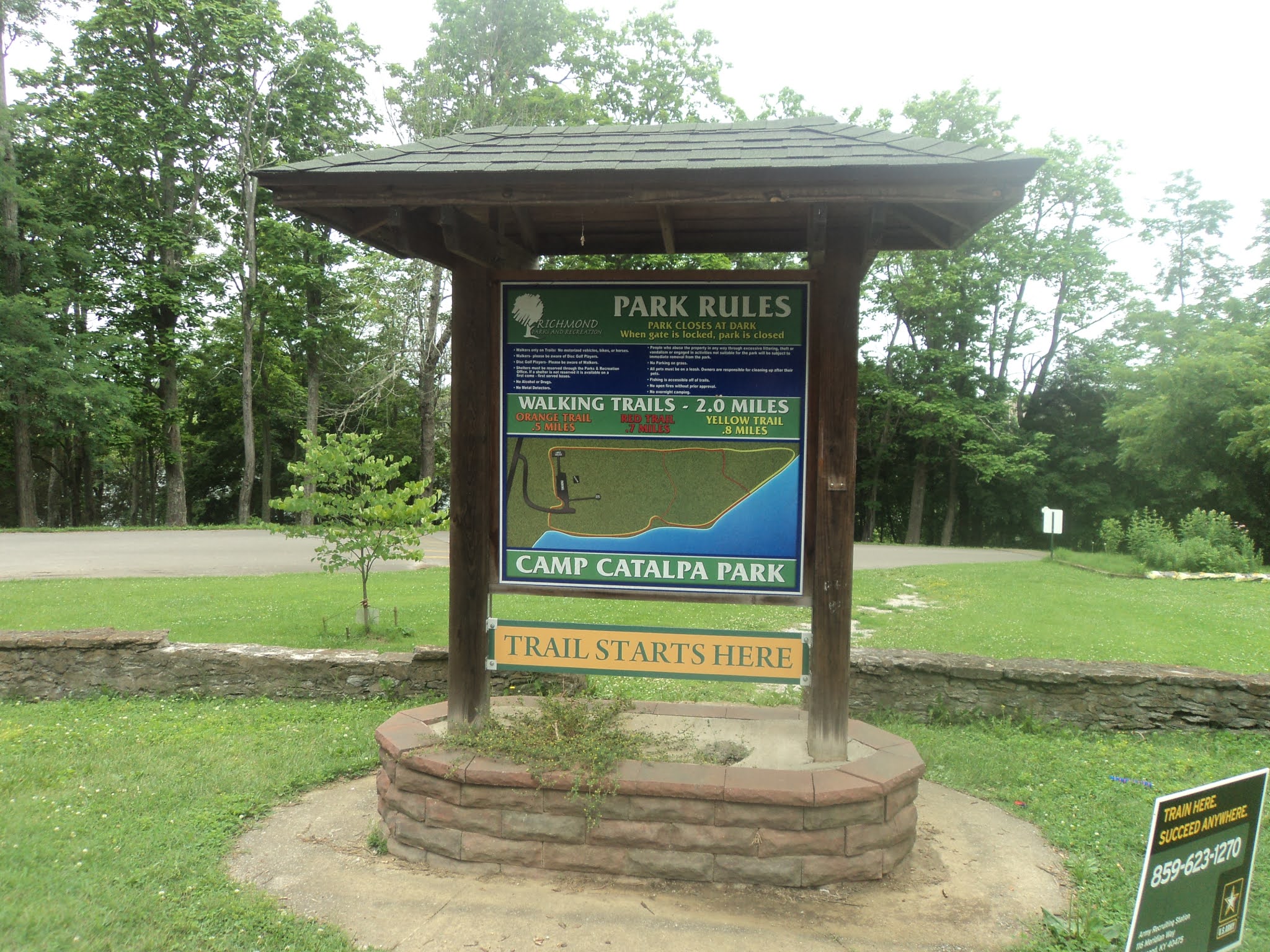
The hike: Owned and maintained by the City of Richmond, tiny Camp Catalpa Park sits on the east side of Reba Lake.  The park provides access to the lake for anglers and canoeists, but it also features a playground, 2 picnic shelters, an excellent disc golf course, and a gravel walking trail organized into three loops of increasing length.  The hike described here takes you around the longest of the three loops, and it makes a nice leg-stretch hike if you are driving I-75 through central Kentucky.
Information board at parking lot
    
        From the information board near the entrance to the parking lot, begin a clockwise journey around the gravel walking trail by heading uphill with the parking lot on your right.  The practice basket and the first two holes on the disc golf course sit downhill to the left here.  The park's grounds are typical city parkland: mowed-grass with a smattering of large trees, but some of the grassy areas needed mowing on my visit.
Hiking along the park boundary
            As you approach the picnic shelter atop the hill, the trail curves right to begin heading south with the park's east boundary on the left.  Where the two shorter loops exit right, stay left to remain on the longest loop.  At 0.2 miles, you reach the only significant downhill portion of this hike.  The difference between maximum and minimum elevations on this hike is only about 60 feet, so the entire trail is fairly easy-going.
View across Reba Lake
    
        As you approach lake level, ignore an unofficial trail that exits left and stay with the gravel trail as it curves right.  The next 0.3 miles stay close to the lake on your left, and nice views of woods and a golf course emerge across the lake.  Stay left after crossing a wooden footbridge.  Soon a gradual climb returns you to the information board to complete the hike.