Thursday, June 26, 2014

Pipestem Resort State Park: Dogwood Trail (Blog Hike #473)

Trail: Dogwood Trail
Hike Location: Pipestem Resort State Park
Geographic Location: northeast of Princeton, WV (37.52548, -80.98915)
Length: 0.7 miles
Difficulty: 3/10 (Easy/Moderate)
Last Hiked: June 2014; trailhead pic taken July 2017
Overview: A short after-dinner nature trail.
Hike Route Map: http://www.mappedometer.com/?maproute=308210
Photo Highlight:

Directions to the trailhead: From I-77, take exit 14 and follow signs to SR 20.  Turn left on SR 20 and drive north 9.3 miles to the park entrance.  Turn left to enter the park.  Drive the main park road 1.6 miles to the parking area for the Nature Center on the left.  Park here; the trail starts behind the Nature Center.

The hike: Consisting of 4050 acres in and around the Bluestone River gorge in southern West Virginia, Pipestem Resort State Park is one of the crown jewels of West Virginia’s state park system.  The park’s name comes from the locally common meadowsweet plant, the hollow stem of which was historically used to make tobacco and other pipes.  Perhaps the park’s most famous feature is its aerial tramway, which takes visitors down 1100 feet to the bottom of the gorge.
            The park has 2 lodges: Mountain Creek Lodge and McKeever Lodge.  Mountain Creek Lodge sits in the gorge next to the river; it is accessible only by trail or the tramway.  McKeever Lodge sits on the canyon rim and offers several gorge view rooms, one of which housed me for two nights.  An 82-site campground and 26 cabins round out the park’s lodging options.  In terms of other amenities, the park boasts two golf courses, a regulation course and a short par-3 course, tennis courts, picnic shelters, a recreation center featuring disc golf among other things, 20 hiking trails, and the Nature Center.
My long hike at Pipestem is described in the next blog entry, but the night before my long hike I chose to hike the short Dogwood Trail described here.  The Nature Center, where this hike begins, is only open from 12:30 to 4:30, but it has an excellent bird-viewing window.  I sat in a rocking chair beside the window for about 30 minutes and saw several goldfinches, several house finches, a woodpecker, a mourning dove, and some titmice among other birds.
Start of Dogwood Trail
            From the grassy area behind the Nature Center, pick up the Dogwood Trail as it dips across a small meadow and heads into the woods on the far side.  Some frogs were croaking up a tune in the small pond to the left of the trail as I walked past.  After climbing slightly, you cross the much wider horse trail.  Continue straight to stay on the blue-blazed Dogwood Trail.
            The trail continues climbing on a gradual grade and comes out beside the main park road.  Rather than crossing the road, the trail stays about 10 feet below road level on the west side of the road, as directed by trail signs.  Daisies grow on the roadside bank in season.
Daisies beside the park road
            At 0.25 miles, the trail curves left to follow an old dirt road as it descends away from the main park road.  2 minutes later, another sign directs you to turn left and leave the old road.  The balance of the trail climbs and descends repeatedly.  At 0.45 miles, a particularly steep climb and descent makes you wonder if a masochist built this trail.  The descent takes you beside the bottom of some low rock outcrops, thus easing your fears.
Hiking the Dogwood Trail
            You pass the other side of the frog pond as you approach the end of the loop.  At 0.6 miles, the County Line Trail and horse trail enter from the right.  100 feet later, turn right to enter the grassy area behind the Nature Center, thus closing the loop.  Stop in the Nature Center for more bird watching if it is open, or browse the pioneer exhibits throughout the grassy area before returning to your car to complete the hike.

Sunday, June 22, 2014

Bluestone State Park: Overlook/Big Pine/River View Loop (Blog Hike #472)

Trails: Overlook, Big Pine, and River View Trails
Hike Location: Bluestone State Park
Geographic Location: south of Hinton, WV (37.61064, -80.93968)
Length: 1.9 miles
Difficulty: 7/10 (Moderate/Difficult)
Date Hiked: June 2014
Overview: An occasionally steep hike on primitive trail featuring an overlook of Bluestone Lake.
Hike Route Map: https://www.mappedometer.com/?maproute=941197
Photo Highlight:

Directions to the trailhead: From I-64, take exit 139 to SR 20 and go south on SR 20.  Drive SR 20 to the town of Hinton, then continue on SR 20 another 5.3 miles to Bluestone Park Road, which is reached just before crossing Bluestone River.  Turn right to enter the park.  Drive past the park office to the tent camping area, which is located on the left just after passing the main campground entrance.  Park in the tent camping area, taking care not to block any of the camp sites.  From I-77, take exit 14 and follow signs to SR 20.  Turn left on SR 20 and drive north 18.2 miles to the park entrance on the left.  Follow the remainder of the directions above.

The hike: Often overlooked in favor of its bigger and better-amenitied brother Pipestem Resort State Park just 10 miles to the south, cozy Bluestone State Park protects 2157 acres of hilly terrain on the north shore of Bluestone Lake.  If you drove down on SR 20 from Hinton, you passed the modern-looking concrete dam that creates this lake on your way in.  A flood-control dam authorized in 1935 by President Roosevelt via executive order, Bluestone Dam was completed by the U.S. Army Corps of Engineers in 1949; the park opened in 1950.  The lake and park get their names from the blue/gray limestone outcrops that line the river upstream.
In addition to boating and fishing opportunities in the lake, the park features 26 cabins, 2 developed camping areas, a tent camping area, and some picnic areas.  For hikers, Bluestone State Park offers 7 trails, none of which form loops if hiked by themselves.  However, there are several ways to combine the park’s trails to form nice dayhiking loops.  The best loop option is the one described here: it features some of the park’s best trails and minimizes the amount of road walking required.
Trailhead: Overlook Trail
            Start by walking back out to the park road.  To get the longest road walk out of the way first, turn right and walk east on the road’s shoulder.  You are looking for the signed trailhead for the Overlook Trail, which sits on the left side of the road 1000 feet ahead.  The Overlook Trail climbs the steep hillside in spits and spurts using several switchbacks.  The trail is occasionally hard to see on the ground, but red plastic squares and some older red paint blazes mark the way.
            At 0.6 miles, you reach the ridge crest and an intersection with the Big Pine Trail.  This hike will eventually turn left here to continue climbing on the Big Pine Trail, but for now turn right to head for the lake overlook.  The trail undulates slightly over and around some rock outcrops for just over 0.1 miles to reach the overlook.  A small opening in the trees frames the lake, surrounding hills, and the SR 20 bridge across the lake.  The main park road lies in sight directly below you.  There are no railings at the cliff edge, so take care where you step as you position yourself for the best view.
Bluestone Lake view from overlook
            The Overlook Trail ends at this overlook, so next you must retrace your steps to the intersection with the Big Pine Trail.  Continue straight on the Big Pine Trail, which climbs along the spine of the ridge.  Contrary to the trail’s name, young maple and oak trees make up the majority of the forest on this ridge.
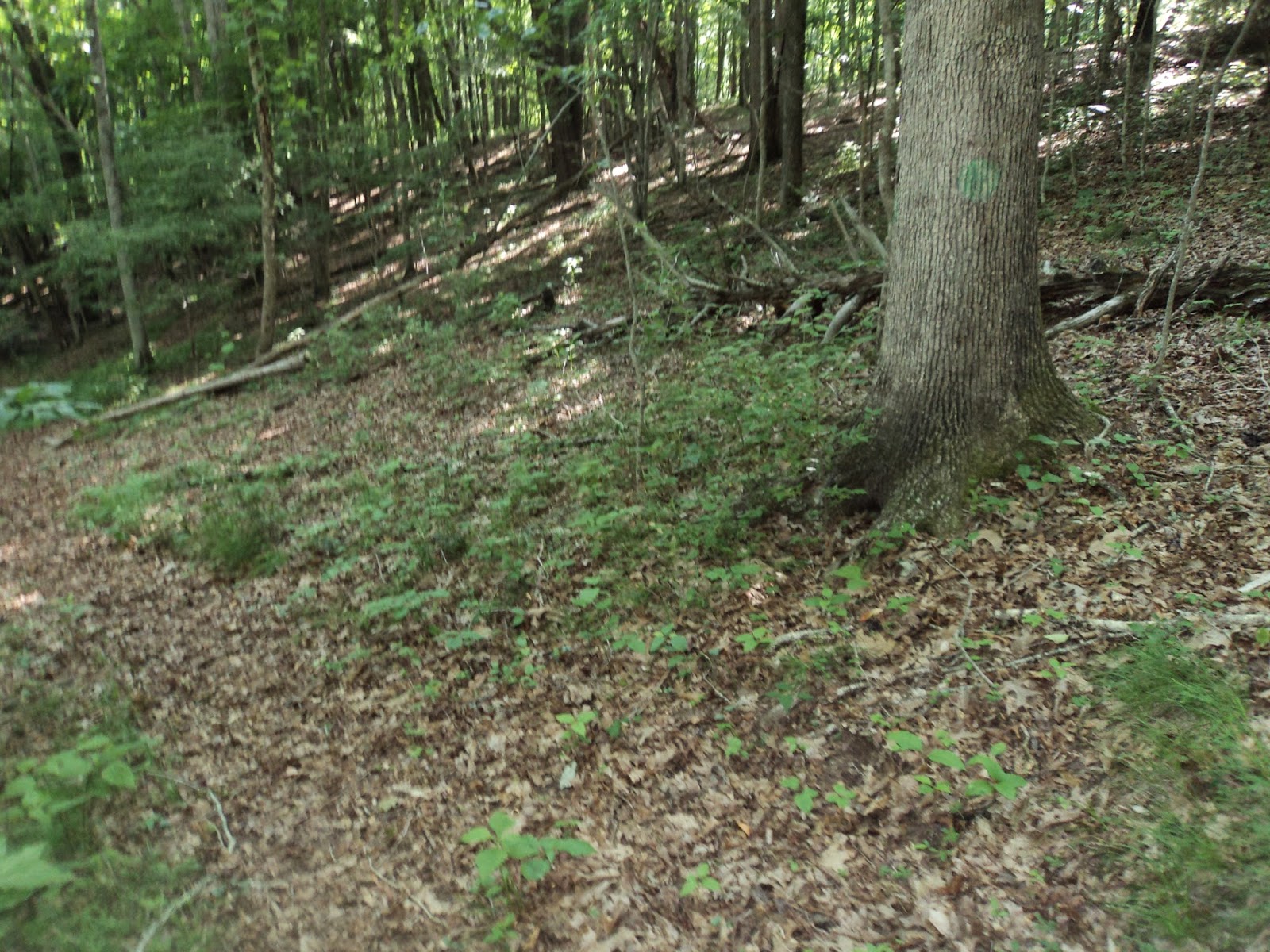
The trail on the ground is hard to discern in places, so you will need to use the green plastic circle blazes or old, faint green paint blazes to guide you.  In general, the trail stays very close to the ridge crest.  I have noticed a trend in West Virginia state parks: the large state resort parks have well-marked and well-trodden trails, while the smaller parks such as this one have primitive trails that can be hard to follow.  Make of the trend what you will, but know what you are getting into with this hike.
Hiking the Big Pine Trail
            Just shy of 1 mile, the trail crosses a power line clearing that offers decent views down either side of the mountain.  One more short, steep climb brings you to the highest elevation on this hike, roughly 325 feet higher than the tent camping area.  Some red paint on trees mark the park boundary; do not mistake them for blazes.
            After descending the west side of the knob into a high saddle, the white-diamond blazed Boundary Trail exits right at 1.2 miles.  The Boundary Trail leads to the park’s cabin area by tracing around the ravine to the right.  Continue straight to stay on the Big Pine Trail.  300 feet later, you reach the junction for the River View Trail, which exits left. (Note: the park map shows the Boundary Trail coming in at the wrong place.)  Turn left on the River View Trail to begin the final leg of the loop.  Note that you could continue straight on the Big Pine Trail to increase the length of this loop, but such a route also increases the length of the road walk at the end.
Junction: Big Pine and River View Trails
            The blue-blazed River View Trail descends on a moderate to steep grade using what appears to be an old roadbed.  At 1.6 miles, the trail leaves the old road by curving right and beginning a series of switchbacks.  Many hikers have cut these switchbacks, but do not yield to this temptation: not only does it make the grade steeper, but cutting switchbacks increases soil erosion. 
At 1.85 miles, you reach the bottom of the switchbacks, where the trail intersects the paved park road.  This intersection marks your exit point from the trail system.  The River View Trail continues straight across the road toward the main campground, but your car sits in the tent camping area, which is located 200 feet down this road to your left.