Tuesday, March 28, 2017

Hot Springs National Park: Peak, Hot Springs Mountain, and Honeysuckle Trails (Blog Hike #623)

Trails: Peak, Hot Springs Mountain, and Huckleberry Trails
Hike Location: Hot Springs National Park
Geographic Location: north side of Hot Springs, AR (34.51371, -93.05346)
Length: 2.7 miles
Difficulty: 7/10 (Moderate)
Date Hiked: March 2017
Overview: A lollipop loop featuring views from Hot Springs Mountain.
Hike Route Map: http://www.mappedometer.com/?maproute=594962
Photo Highlight:

Directions to the trailhead: This hike starts in downtown Hot Springs at the Hot Springs National Park Visitor Center on Central Avenue 750 feet north of Reserve Street, but the National Park Service provides no parking.  Thus, you need to use the City of Hot Springs’ parking facilities, which include street parking and a free garage on Exchange Street 1 block west of the Visitor Center.

The hike: The 143° F water that pours from the base of Hot Springs Mountain has drawn visitors to the eastern Ouachita (pronounced WASH-ee-tah) Mountains for centuries.  Before European settlement, earlier people viewed the springs as neutral territory accessible by all tribes.  After the United States acquired the springs from France as part of the Louisiana Purchase, an expedition sent by President Jefferson reported on the area and ignited general public interest in the hot springs.  In 1832, an act of Congress established the Hot Springs Reservation that protected 4 square miles of land and all of the thermal springs contained therein.  Although the national park was not established until 1921, this act made what would become Hot Springs National Park the first federal reservation to protect a natural resource.
The designation did not prevent private bathhouses from opening in the area.  As you would expect for an early to mid 1800’s frontier city, the earliest bathhouses were nothing more than crude canvas and lumber structures.  By the late 1800’s, luxurious European-style bathhouses had replaced the earlier primitive buildings.  With the advent of modern medicine in the 1900’s, hot springs bathing declined, and the oldest remaining bathhouses today date to the early 1900’s.
            As old as the area’s bathing tradition is, the hot water that powered the area’s bathing history is even older.  For thousands of years rain water filters down through increasingly warmer rock that gets its heat from pressure rather than volcanic forces (i.e. geysers such as those at Yellowstone).  The water gathers minerals from the surrounding rocks as it descends.  Eventually the water meets cracks that lead up to the west slope of Hot Springs Mountain, where it surfaces via the hot springs.
            While the historic bathhouses and hot spring mineral water remain the park’s main attractions, Hot Springs National Park has more traditional park-like amenities as well.  The National Park Service operates the 44-site Gulpha Gorge Campground on the northeast side of Hot Springs Mountain.  Also, a well-constructed and maintained system of hiking trails traverses the mountains east and west of the historic bathhouses.  This hike explores the trail system on Hot Springs Mountain directly east of bathhouse row.
Bathhouse row, downtown Hot Springs

Thermal water fountain
            The hike starts on the Peak Trail, so your first task is to find the Peak Trail.  After walking out the front door of the Visitor Center, walk down the ramp to the right to reach a fountain from which the area’s famous 143° water flows.  Then turn right, walk along a brick path, climb some concrete steps, and angle left to begin a paved trail called the Tufa Terrace Trail.  In less than 0.1 miles, the Tufa Terrace Trail crosses the Peak Trail that you are seeking.  Turn right to begin climbing on the Peak Trail, which is marked with white paint blazes.
            True to its name, the Peak Trail goes directly up the south side of Hot Springs Mountain.  The steepest part of the climb comes at the very beginning, but the climb is persistent throughout with only an occasional switchback to ease the grade.  In total, the Peak Trail gains just over 400 feet in its 0.6 miles.  The concrete path becomes a wide dirt path after you cross Hot Springs Mountain Drive, a steep switchbacking vehicle road that leads to the same destination as this trail.
Climbing on the Peak Trail
            At 0.25 miles, you reach an intersection with the Honeysuckle Trail that forms this hike’s loop around Hot Springs Mountain.  This hike will continue straight to keep climbing on the Peak Trail and use the Honeysuckle Trail that goes left as its return route, thus hiking the loop counterclockwise.  As you continue climbing, some minor erosion appears in the dirt/gravel trail, a result of this trail’s lack of waterbars or switchbacks.
            Just shy of 0.5 miles, you cross Hot Springs Mountain Drive just after it splits to form its loop around the mountain.  You will need to walk about 100 feet to the right on the road in order to find where the white blazes continue on the uphill side of the road.  The blue-blazed Hot Springs Mountain Trail also crosses the road here.  We will eventually come back here and hike the Hot Springs Mountain Trail, but for now continue climbing on the Peak Trail to keep heading for the summit.
Hot Springs Mountain Tower
            At 0.6 miles, the Peak Trail ends in back of Hot Springs Mountain TowerHot Springs Mountain has two summits, and the 1060-foot south summit on which this tower stands is 60 feet lower than the north summit, which stands almost 1 mile away.  For a fee you can ride elevators to the observation deck on top of the tower, which offers 360-degree views of the surrounding area including the town of Hot Springs.  Be a little careful if you choose to go to the observation deck: one group of people got stuck in an elevator just before I went up, but my trip up and down went without incident.
Downtown Hot Springs, as seen from observation deck
            After visiting the tower, backtrack down the Peak Trail to the blue-blazed Hot Springs Mountain Trail and turn left to begin a counterclockwise journey around the Hot Springs Mountain Trail, which forms a loose loop around the southern summit of its namesake mountain.  For the next 0.7 miles the trail undulates gently as it heads northeast just downhill from Hot Springs Mountain Drive.  A couple of roadside overlooks provide nice un-tower-aided views to the east.
Road side view to the east
            1.4 miles into the hike, the trail climbs slightly to reach a trail intersection and another crossing of Hot Springs Mountain Drive.  A stone trail shelter stands here.  The Gulpha Gorge Trail exits right and goes downhill for 0.6 steep miles to the Gulpha Gorge Campground, passing intersections with the Goat Rock and Dead Chief Trails on its way.  If you wanted to add another 1.9 miles to this hike, you could use the Gulpha Gorge, Goat Rock, and Upper Dogwood Trails to form an additional loop around the mountain’s north summit.  This description crosses the road to stay on the Hot Springs Mountain Trail.
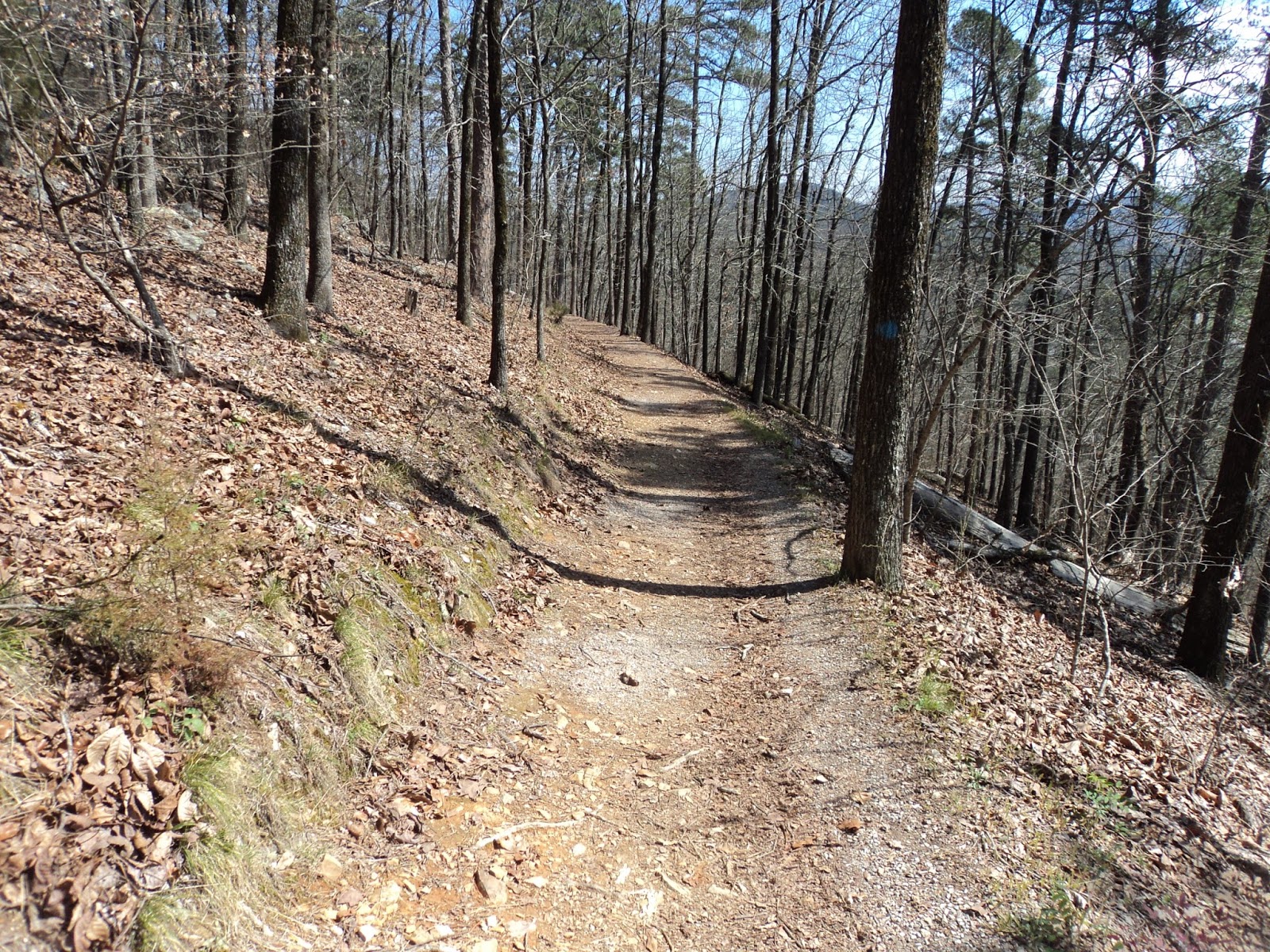
Hiking the Hot Springs Mountain Trail
            Now on the west side of the mountain, the trail descends on a gradual to moderate grade into the head of the ravine that leads to the luxurious Arlington Hotel.  The Upper Dogwood Trail (the end of the hike extension suggested above) soon exits right.  At 1.8 miles, the trail crosses Fountain Street and reenters the forest on the other side.
            2 miles into the hike, you reach an intersection with the orange-blazed Honeysuckle Trail, where you will need to make a decision on how you want to get back to the Peak Trail.  You could continue another 0.2 miles on the Hot Springs Mountain Trail to return to its intersection with the Peak Trail, or you could take the Honeysuckle Trail to its lower elevation intersection with the Peak Trail.  For more variety, this description will angle right to begin the Honeysuckle Trail.
Stone trail shelter
            The Honeysuckle Trail descends rather steeply over some large loose gravel to reach another stone trail shelter where the Floral Trail exits right.  Continue straight to keep descending on the Honeysuckle Trail.  The trail reaches its lowest elevation where a set of concrete steps lead down and right to Fountain Street.  A moderate climb brings you to the Peak Trail to close the loop.  A right turn and 0.25 miles of retracing your steps back to downtown Hot Springs remains to complete the hike.  While you are in Hot Springs, be sure to tour some of the former bathhouses and visit some of the interesting shops that line Central Avenue.

Tuesday, March 21, 2017

Pinnacle Mountain State Park: West Summit and Base Trails (Blog Hike #622)

Trails: West Summit and Base Trails
Hike Location: Pinnacle Mountain State Park
Geographic Location: west of Little Rock, AR (34.83948, -92.49320)
Length: 4.1 miles
Difficulty: 10/10 (Difficult)
Date Hiked: March 2017
Overview: A steep rocky hike to the summit of Pinnacle Mountain followed by a moderate trip around its base.
Hike Route Map: https://www.mappedometer.com/?maproute=732436
Photo Highlight:

Directions to the trailhead: On the west side of Little Rock, take I-430 to SR 10 (exit 9).  (Note: Little Rock has both an I-430 and an I-440; do not get them confused.)  Exit and go west on SR 10.  Drive SR 10 west 6.1 miles to SR 300 and turn right on SR 300.  Drive SR 300 north 1.7 miles to Pinnacle Mountain State Park’s signed West Summit Picnic Area on the right.  Turn right to enter the area, and park in the large paved parking lot.

The hike: As you journey west up the Arkansas River from its mouth at the Mississippi River, the first significant landmark you reach is a small 18-foot high rock outcrop that French explorers in the 1720’s called le petit rocherLe petit rocher marks the transition from the nearly flat Mississippi River plain to the low, fold-type Ouachita (pronounced WASH-ee-tah) Mountains, a now-separate chain that used to be part of the Appalachians.  As anyone with a rudimentary knowledge of French would guess, le petit rocher is the site of present-day Little Rock, the largest city and capital of Arkansas.
            Only 10 miles west of Little Rock stands a much bigger rock known as Pinnacle Mountain, the centerpiece of 2356-acre Pinnacle Mountain State Park.  Established in 1977, Pinnacle Mountain State Park was Arkansas’ first state park in a suburban area. The park is solely a day-use park, and it features only a boat launch, Visitor Center, and some picnic shelters in terms of facilities.
            Pinnacle Mountain State Park offers many trails for bikers and hikers, and it is the eastern terminus of the 233-mile Ouachita Trail, one of Arkansas’ premier backpacking trails.  By far the park’s most popular hiking destination is the 1011-foot summit of Pinnacle Mountain, which can be seen standing more than 700 feet above the West Summit Picnic Area, the trailhead for this hike.  The steep, bare, boulder-covered mountain looks intimidating, and getting to the summit is as hard as it looks.  This hike combines a trip to the summit with a loop around Pinnacle Mountain’s base, thus allowing you to explore all aspects of the mountain.
West Summit Picnic Area trailhead
            The hike starts with a trip up the West Summit Trail, which begins at a colorful covered bridge-looking portal near the center of the picnic area.  Some park brochures and a trail map are also available here.  The stone steps begin immediately, and after only 300 feet you reach a junction with the Base Trail, which goes left and right.  We will eventually go clockwise around the Base Trail, but for now continue straight on the West Summit Trail.
            Soon you pass marker #1 as you head up 5 switchbacks and pass an iron railing that protects you from a small vertical drop on your left.  The West Summit Trail features 10 trail markers that you pass in increasing order as you climb to the summit.  5 benches also lie between you and the summit, and the benches combine with the trail markers to give this trail a front country feel in spite of the persistent steepness and rockiness.  I also encountered quite a bit of traffic on this trail even though I made the ascent on a cloudy seasonally cold mid-March morning.
View at second bench
            Just past marker #5, you pass the second bench.  This bench offers a nice view to the southwest during the leafless months.  At marker #6, the difficulty increases as the trail enters the first boulder field.  The boulder field is fairly exposed to the sun, and I would not want to be climbing over these boulders if they were slippery due to rain or ice.  Yellow blazes have been painted on the boulders to keep you on the trail.
Entering the boulder field
            At marker #7, the trail splits only to merge again in a few hundred feet.  As a sign explains, the left option is longer but less rocky, while the right option goes directly up the boulders.  Just past marker #8, the two options re-merge for the final steep, rocky push to the summit.  The last 1000 feet is a true New England-style boulder scramble.  An unofficial slightly less rocky line can be found to the left, but that area has been closed to help prevent erosion.
            At 0.7 miles, you reach a high saddle in between Pinnacle Mountain’s two summits: the slightly higher east summit and slightly narrower west summit.  The two summits offer different views, so you will want to climb over the remaining boulders and visit both of them.  The view east features the Arkansas River and, on a clear day, downtown Little Rock, while the view west features Lake Maumelle.  These views are hard-earned, so take some time to have a trail snack and see what you can see.
View east toward Little Rock

View of Lake Maumelle
            Another trail, the East Summit Trail marked by white rectangles with red borders, also departs the summit area, but it is even steeper and rockier than the West Summit Trail you came up on.  Also, going down the East Summit Trail would cause you to miss half of the Base Trail.  Thus, this hike goes back down the West Summit Trail to its junction with the Base Trail.  If all you want to do is visit the summit, the trailhead is only 300 feet past the Base Trail junction.  To get the full tour, turn right on the Base Trail to begin a clockwise journey around Pinnacle Mountain’s base.
            The Base Trail does not provide any grand views, but it does offer other rewards such as a nice wildflower display in the spring.  Also, because most people only hike to the summit, you will likely leave the crowds behind when you start the Base Trail.  Just as the West Summit Trail featured 10 trail markers, the Base Trail features 29 trail markers that you will pass in increasing order as you hike clockwise.  The trail markers on the Base Trail are painted neon green, as are the blazes that mark this trail.
Hiking the Base Trail
            The Base Trail ascends and descends on gradual to moderate grades, and although the Base Trail has a few rocky sections, it seems like a breeze compared to the steep and rocky West Summit Trail you just descended.  The trail curves gradually right as noise from SR 300 comes in from the left.  The road noise brings up the only down side to hiking the Base Trail: it stays near the park’s boundary for most of its distance, so the park’s suburban location ensures that signs of civilization such as roads, buildings, power lines, and railroad tracks are nearly always in sight.
            1.6 miles into the hike (or 0.2 miles into the Base Trail), you cross a gravel service road as you begin a moderate descent.  At 2.2 miles, the long-distance Ouachita Trail mentioned in the introduction enters from the left.  For the next 0.5 miles the blue blazes of the Ouachita Trail and the neon green blazes of the Base Trail run conjointly as the trail heads east along the north slope of Pinnacle Mountain.  Some short metal bridges carry you over some small creeks.
Metal bridge over small creek
            At 2.7 miles, you reach a junction with the East Summit Trail less than 100 feet from the East Summit Trail parking lot.  The Ouachita Trail exits left here, and the East Summit Trail briefly joins the Base Trail before exiting right to begin its steep, rocky climb to the summit.  Follow the neon green blazes to stay on the Base Trail.
Little Maumelle River
            Now on the east side of the mountain, some high voltage power lines come very near the trail on the left, but the trail stays on the west side of the power line clearing.  The power lines are soon replaced by railroad tracks and then by the Little Maumelle River, which was calm and cloudy on my visit.  The trail passes through one final rocky area as the West Summit Picnic Area comes into view downhill ahead and to the left.
Just past 4 miles, you close the Base Trail’s loop.  Turn left and hike the remaining short segment of the West Summit Trail to return to the picnic area and complete the hike.  While you are at Pinnacle Mountain State Park, be sure to stop by the Visitor Center, which has some interesting exhibits and offers a postcard view from its back patio high above the Arkansas River.