Monday, July 25, 2016

Grindstone Nature Area: Grindstone Nature Trail (Blog Hike #597)

Trail: Grindstone Nature Trail
Hike Location: Grindstone Nature Area
Geographic Location: south side of Columbia, MO (38.92584, -92.31166)
Length: 1.7 miles
Difficulty: 3/10 (Easy/Moderate)
Date Hiked: June 2016
Overview: A lollipop loop through an old agricultural area and atop limestone cliffs.
Hike Route Map: http://www.mappedometer.com/?maproute=537614
Photo Highlight:

Directions to the trailhead: Near Columbia, take I-70 to US 63 (exit 128A).  Exit and go south on US 63.  Drive US 63 south 1.9 miles to SR 740.  Exit and turn right on SR 740.  Drive SR 740 west 0.9 miles to Old US 63 and turn left on Old US 63.  Drive Old US 63 south 0.4 miles to the park entrance on the right.  Turn right to enter the park, and park in the only parking lot.

The hike: Located just off campus from the University of Missouri, Grindstone Nature Area protects 199 acres along Grindstone and Hinkson Creeks.  The historic Boone’s Lick Trail, a major route across Missouri used by early settlers, passed through this area in the early 1800’s.  Corn and other crops were grown on this land for many years, and some evidence of this land’s agricultural past will be seen on this hike.  The City of Columbia purchased the land in 1975 as part of a greenbelt plan, thus forming the park.
            True to its name, Grindstone Nature Area has only a parking lot, a restroom building, a picnic shelter, and an off-leash dog area for amenities, so nature is allowed to take center stage.  Two concrete bike paths have trailheads here, and several miles of natural surface trails pass through the Nature Area.  Grindstone Nature Area also features two creeks that, like many of central Missouri’s waterways, are lined with tall limestone cliffs.  While several routes are possible, the route suggested here takes you past some of this land’s agricultural remnants and atop the limestone cliffs.
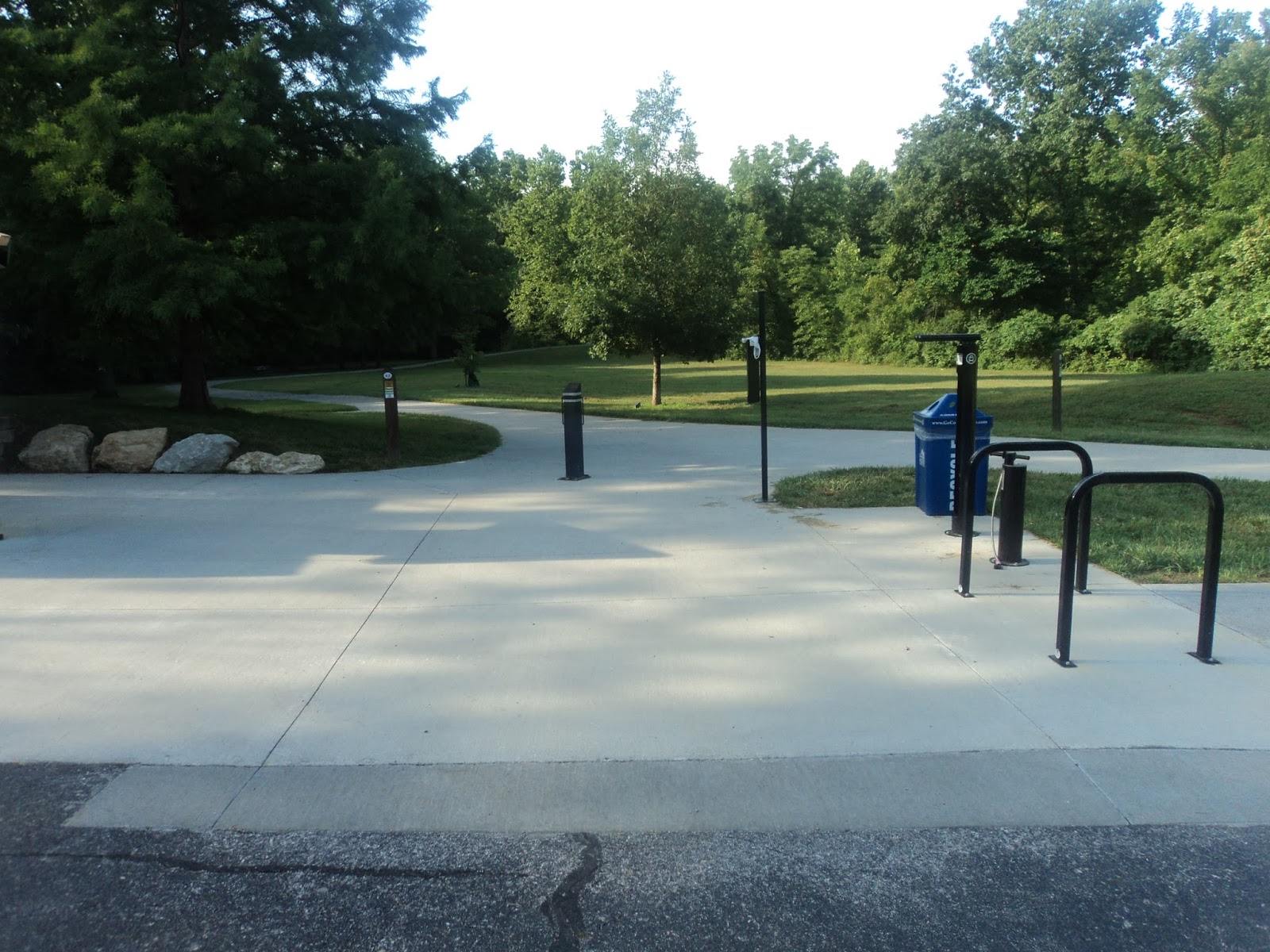
Trailhead area: Hinkson Creek Trail
            This hike starts at the rear of the parking lot on the crushed gravel Hinkson Creek Trail, which is also open to mountain bikes.  The Hinkson Creek Trail links the nature area to the University of Missouri campus.  The trail curves right to cross Grindstone Creek on an iron bridge with wooden deck.  The Ridgeline Trail exits left in this area, but it was very overgrown on my visit.
            After crossing Grindstone Creek, look for the mulch trail that exits the bike path on the right.  This mulch path is the start of the hiker-only Grindstone Nature Trail, so angle right to begin the Nature Trail.  Less than 200 feet later, you pass a tall concrete silo on the right, one of the reminders of this area’s agricultural history.
Concrete silo
            Just past the silo, the trail splits to form its loop.  This hike will continue straight on a path that heads up the right side of a prairie planting and use the narrow path exiting right into the woods as its return route.  None of the trails at Grindstone Nature Area are marked or signed.  With the many narrow and winding trails that exist here, this trail system could really benefit from some better trail markings to make trails and trail intersections easier to identify.
            The grass-dirt trail heads northwest in almost a straight line with the prairie planting on your left and the woods on your right.  Continue straight wherever side trails exit left or right.  At one point the trail seems to head into the woods on a mulch path, but it quickly comes back out into the prairie.
Hiking through the prairie
            Just shy of 0.7 miles, you reach a T-intersection at the northwest edge of the prairie with options going left and right.  The trail going left quickly leads back to the gravel Hinkson Creek Trail, and it could be used if you wanted a hike entirely in the prairie.  To also see the limestone cliffs for which this part of Missouri is famous, turn right to begin following a sewer line, a reminder of this hike’s suburban setting.
            Upon reaching the edge of the prairie, turn left to head into the woods, which features a large number of cottonwood trees.  The trail surface turns to packed dirt as it curves right to begin paralleling Hinkson Creek.  Some narrow trails exit left and right, but the main trail assumes a southeasterly course with the creek several feet to your left.  As I mentioned above, some trail markings would really help here.  Also, the packed dirt soil can become quite slippery when wet, so take your time and watch your step.
Climbing gradually
            Slowly but surely you gain elevation as you climb to the bluffs overlooking first Hinkson and then Grindstone Creeks.  There are no developed overlooks, but some spur trails take you to the edge of the cliff, which stands some 70 feet above the creek level.  At first trees block any views, but finally at 1.2 miles a clear view over an apartment complex to the east emerges.  No railings guard the edge of the cliff, so mind your position relative to the drop-off.
View from cliff top

Looking down from the cliffs at Grindstone Creek
            The trail becomes a bit rockier and narrower as you continue southeast.  A brief descent precedes a brief ascent to the bluffs overlooking Grindstone Creek.  The creek waters are visible below, but trees block any expansive views.  A final descent brings you to the mulch trail beside the old concrete silo to close the loop.  A left turn returns you to the packed gravel Hinkson Creek Trail, where another left turn returns you to the parking lot to complete the hike.

Sunday, July 24, 2016

Pioneers Park Nature Center in Lincoln, NE (Blog Hike #596)

Trails: (unnamed)
Hike Location: Pioneers Park Nature Center
Geographic Location: west side of Lincoln, NE (40.77445, -96.77537)
Length: 1.9 miles
Difficulty: 2/10 (Easy)
Date Hiked: June 2016
Overview: A loop hike through various kinds of prairie wetlands.
Hike Route Map: http://www.mappedometer.com/?maproute=537609
Photo Highlight:

Directions to the trailhead: On the west side of Lincoln, take US 73 to Van Dorn Avenue.  Exit and go west on Van Dorn Ave.  Drive Van Dorn Ave. west 1.6 miles to the main entrance for Pioneers Park, which is on the left.  Turn left to enter the park, then take a series of rights to follow signs for the Nature Center.  Park in the Nature Center’s concrete lot on the right side of the road.

The hike: Established in 1963, 950 acre Pioneers Park is the crown jewel of the City of Lincoln Parks and Recreation Department.  The original 500 acres were donated to the city in 1930 by John F. Harris as a Christmas gift.  The park’s many amenities include a golf course, an amphitheater that hosts an annual summer concert series, numerous ball fields, a bison pasture, and several miles of paved bike paths.  The developed areas of the park are popular for gatherings and festivals, including two that I drove past on my way to the trailhead.  The drive to the trailhead also passes some interesting statues, some of which date to the early 1900’s.
            Fortunately for hikers, Pioneers Park’s western 668 acres have been preserved in their natural state as Pioneers Park Nature Center.  The natural area straddles Haines Branch Creek, but the trails south of the creek were closed due to construction on my visit.  Thus, the hike described here visits all of the park’s major points of interest north of Haines Branch Creek.
Trail entrance gate
            From the parking area, cross the entrance road and enter the Nature Center through a gate in a chain link fence.  Note the time when this gate is scheduled to close (5pm on my visit) and make sure you plan to be out well before then.  Our tour through the trail system turns left on the mulch trail reached immediately after walking through the gate.  You may want to check out the exhibits and pick up a trail map in the Chet Ager Building directly ahead before you start your tour of the natural area, but the exhibit building was also closed due to construction on my visit.
            The mulch trail heads east before making a sweeping 180-degree right turn around a demonstration beehive.  Soon the first of many seasonal wetlands appears on the left.  The trail map calls this area the Wood Duck Wetlands, but the frogs greatly outnumbered the ducks on the hot early afternoon of my visit.  All of the ponds at Pioneers Park were dug in the 1930’s in an attempt to attract more water fowl, but the lack of springs in this area means that they only have water when runoff is sufficient to fill them.  The ponds were nearly full on my late June hike, but they have been known to dry up completely during a drought.
Wood Duck Wetlands
            At 0.2 miles, you reach a trail intersection located directly in front of the Chet Ager Building.  To head deeper into the natural area, turn left to tread a narrow strip of land between the Wood Duck Wetlands on the left and the larger Heron Wetlands on the right.  When I walked by this side of the Heron Wetlands, a blue heron flew above the water right on cue.
            After crossing a wooden footbridge over a small channel that connects the two wetlands, you reach another trail intersection.  Angle left here to begin walking an old road and head for Fleming Woods, this hike’s next destination.  The trail soon jogs right to leave the old road and pass through another gate in another chain link fence.  This gate marks your entrance to Fleming Woods, and it too has a posted scheduled closing time.
Hiking through Fleming Woods
Fleming Woods is a fairly small grove dominated by oak trees, and a double loop takes you through the area.  This double loop used to be a triple loop, but part of the last loop got washed out by a Haines Branch Creek flood a few years ago.  Thus, if you accidentally start the third loop, which is easy to do because none of the trails are signed or marked, you will have to backtrack to continue the second loop.
            0.6 miles into the hike, a short narrow spur trail to Owl Point exits left.  Owl Point forms a wide 180-degree bend in Haines Branch Creek, and a staircase gives access to the stream.  Contrary to what you might expect this far from the sea, the water in Haines Branch Creek is slightly salty due to this area’s large salt deposits.  The steps to the creek were very overgrown with grass when I came here, and the overall level of maintenance throughout the trail system was adequate but less than ideal.
Haines Branch Creek
            After closing the Fleming Woods loop and walking back out the chain link fence gate, angle left at the next few trail intersections.  At 0.9 miles, you reach the north end of a suspension bridge over Haines Branch Creek.  Consisting of a wooden deck strung from steel cables, this suspension bridge is the park’s only route across the creek.  Over 3 miles of trails lie south of the creek, and you should feel free to cross the bridge and hike them if they are open on your visit, which they were not on mine.  Thus, I had to continue straight to stay on the north side of the creek.  The trail map calls this trail the Animal Trail though no signs on the ground indicate such.
            At 1.05 miles, you enter the sunny prairie just before reaching a signed trail intersection.  The trail going straight provides the shortest route back to the parking area, but I suggest turning left to hike a loop through the lowland prairie.  The wide dirt/grass trail heads west with the Muskrat Wetland, which is constantly visible on the right.  I saw more birds and another heron in this seasonal wetland.
Muskrat Wetland
            As you approach the park’s western boundary, the trail curves right to cross a pair of boardwalks over wet areas.  The park’s bison pasture appears over a fence to the left, but I saw no bison on my hike.  After tracing along the north side of the Muskrat Wetland, you reach the end of the lowland prairie loop, where a left turn is required to continue this hike.
            The trail joins an old gravel road as it passes a small aviary on the right.  The aviary features hawks, owls, eagles, and turkeys, and the birds in these cages are here because they have sustained injury and could not survive in the wild.  Just before reaching the park road, the trail curves right to head through a narrow strip of woods with the paved road on the left and the Heron Wetlands on the right.  Heading east parallel to the park road, you pass some flower beds to reach the main trail entrance gate, where a left turn exits the natural area and returns you to the parking lot.